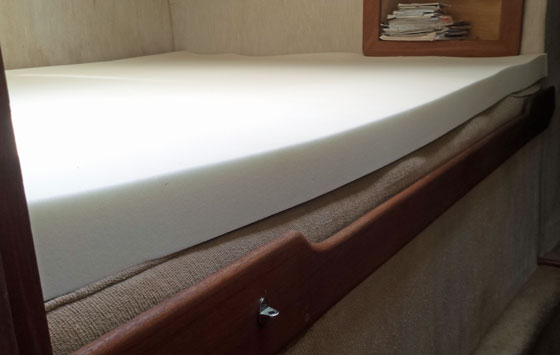
Sleeping well on a boat makes everything better — and after 17 years of living aboard, I can tell you that a comfortable bed is right up there with staying warm/cool, dry, and well-fed. When you sleep well, you want to be out there. When you don’t, the boat starts to feel like something to endure.
The problem is that most boat beds are an afterthought. When we bought Barefoot Gal, the “mattress” was 2″ cushions that had lost whatever cushioning they ever had. One flat, lumpy pillow. Scratchy sheets with no elastic left. A mildewed comforter. It was grim.
Here’s what we did to fix it — layer by layer.
Mattress Topper: A Better Option Than Replacing the Whole Mattress
Before you spend $1,000 or more on a custom boat mattress, consider this: a quality memory foam topper over your existing cushions will very likely solve the problem for a fraction of the cost. It’s what other cruisers recommended to us, and it worked perfectly.
You get to choose both thickness and density to match how you sleep.
Thickness: Most people find 3″ or 4″ far more comfortable than 2″. We chose 3″ as a good compromise on weight and ease of handling aboard. If your overhead clearance is tight, keep that in mind — an extra inch of topper means an inch less headroom when you’re sitting up in bed, so going thinner may actually serve you better.
Density: Foam density runs from 3 to 6 pounds per cubic foot — the denser, the firmer. Side sleepers generally do well with 3 to 4 lb density; back sleepers usually prefer 4.5 to 6 lb. We’re both side sleepers and went with 4 lb.
Gel foam: Newer gel versions sleep cooler but cost more. With a waterproof mattress cover (more on that below), heat hasn’t been an issue for us without the gel.
If your berth is a non-standard size or a V-berth, you can cut a topper down with a serrated knife or, much more easily, an electric knife. You can often find one inexpensively at a resale shop.
A few practical things to know before you buy:
- Don’t open the packaging until you’re ready to put it directly in place on the boat. If you want to let it air out first, unpack it somewhere close by — a dock, a cockpit, a friend’s slip. Once it’s out of the bag and fully expanded, there is no getting it into a dinghy.
- It takes 2 to 4 days to fully expand after unpackaging.
- It’s floppy and “sticky” — you need two people to get it down a companionway or through tight doorways.
- Expect a smell when you first open it. It’s harmless and fades within a few days to a couple of weeks. Unpackaging off the boat and letting it air out first helps.
3″ memory foam mattress topper (Amazon)

Waterproof Mattress Pad
Boats leak. With a mast coming through the cabin top near our berth and a hatch overhead, I wasn’t willing to risk soaking the mattress in a rainstorm or a breaking wave. Sheets and bedding can dry out; a waterproof mattress pad protects everything underneath.
Modern waterproof pads don’t feel like sleeping on a plastic tarp. Look for one described as terry cloth on the surface and “noiseless.” Make sure it’s breathable or it’ll trap heat.
A waterproof pad also blocks allergens, mold, and mildew — which matters a lot in the marine environment. For more on keeping mold at bay aboard, see Mold and Mildew on a Boat.
Waterproof hypoallergenic mattress pad (Amazon) (various sizes available — note that V-berth shapes will likely need some customizing to fit)
Pillows
I had no idea how much a good pillow contributed to good sleep until we upgraded. My favorites are the contour “butterfly” style — they look odd but they work beautifully. A friend I’d recommended them to wrote back: “OMG. These pillows are the best thing ever. I had no idea how much better I’d sleep.”
Odorless ergonomic contour memory foam pillows (Amazon)
Pillow Covers
With all the mold, mildew, and allergens a boat produces, we added zippered pillow encasements under our pillowcases. They go on once, you forget they’re there, and once or twice a year you pull them off and run them through a hot wash. Much easier than trying to wash expensive pillows — and it protects them for years.
One important note: make sure any encasement you buy has nylon or plastic zippers. Metal zippers rust in the marine environment.
Aller-Ease 100% cotton dust mite and allergy control pillow encasement (Amazon) (standard, queen, and king sizes available)
Sheets
Getting sheets to stay on a boat bed is one of the most maddening parts of boat life. Even with a topper, the mattress isn’t nearly as thick as a home mattress — so standard fitted sheets pop off the moment you roll over. I woke up more than once as the stuffing inside a sheet burrito.
V-berths are even worse. Standard sheets simply don’t fit.
I’ve tried elastic straps under the mattress. They work okay but are a real pain at sheet-changing time, especially when one side of the bed is against a hull. The better solution is sheets made specifically for boat beds.
Quahog Bay Bedding makes sheets for both rectangular berths and V-berths. The bottom sheet is oversized with an elastic drawstring you tighten for a snug, pop-proof fit. The fabric is 600 thread count cotton — genuinely luxurious. I’ve been using their sheets for years and they hold up beautifully despite near-constant use. See my full Quahog Bay review for the details.
For a full comparison of all the sheet options out there, I’ve also written a guide to the best sheets for boats.
One fabric note: I prefer all-natural fabrics — cotton or bamboo — in the humid marine environment. Cotton/poly blends and microfibers feel much wetter to me and take longer to dry out from body heat when you climb in.
Quilt or Duvet
Even in the Florida Keys and Mexico, there are chilly nights when you want something to burrow into. For our first year on Barefoot Gal we used an old fleece blanket — perfectly fine but nothing special.
Quahog Bay offers a duvet and several cover options with pillow shams sized for boat berths and V-berths. Worth a look if you want bedding that actually fits and feels like it belongs there.
Bedside Storage
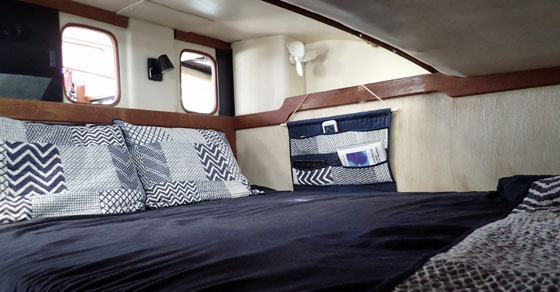
One last thing that made a real difference: somewhere to put your book, glasses, phone, and all the other things you want within reach at night. A wall-mounted pocket organizer — the kind with fabric pockets that attaches to the bulkhead beside the berth — works well in the space where a nightstand would be impossible. A quick search for “bedside wall organizer” or “bedside caddy” will turn up plenty of options.
The Payoff
Cruising shouldn’t mean making do. A comfortable bed — even a genuinely luxurious one — is achievable on a boat, and it changes your whole relationship with being aboard. When you’re well rested, you want to be out there. Passages are more enjoyable, watches feel shorter, and the boat feels like home instead of a place you’re just tolerating.
A comfortable bed is only part of the sleep picture, though. If you’re lying awake wondering whether the anchor is holding, all the memory foam in the world won’t help. Here’s how to use an anchor alarm so you can actually trust your hook and sleep soundly at anchor.
Ready to Go Further?
Bedding is one of 31 topics covered in The Basics of Living on a Boat, my course on the practical realities of life aboard that most people don’t realize they need to know until they’re already out there. If you’re in the planning stages or your first year of cruising, it’s the shortcut I wish I’d had.

Carolyn Shearlock has lived aboard full-time for 17 years, splitting her time between a Tayana 37 monohull and a Gemini 105 catamaran. She’s cruised over 14,000 miles, from Pacific Mexico and Central America to Florida and the Bahamas, gaining firsthand experience with the joys and challenges of life on the water.
Through The Boat Galley, Carolyn has helped thousands of people explore, prepare for, and enjoy life afloat. She shares her expertise as an instructor at Cruisers University, in leading boating publications, and through her bestselling book, The Boat Galley Cookbook. She is passionate about helping others embark on their liveaboard journey—making life on the water simpler, safer, and more enjoyable.


Charlotte Taylor says
Cynthia Lee Goodman-Degnan. FYI.
Cathy Coyne Wehle says
Sounds like this will fit our needs
Thomas Keenan says
Kelly Jennings
Michael Mangione says
Good Article. On Sea Change we are fans of natural latex toppers. Since they are natural, they don’t tend to “off gas” like some of the other non natural products. This can be a problem in the confined spaces of a boat bunk. The natural toppers tend to be more expensive, but IKEA sells a reasonably good product. It’s natural latex with a removable cotton cover that can be easily washed in an oversized machine.
Pamela Harwood says
I’ve just put in an order for the cinchable bamboo sheet set. Solved 2 of my problems! We MUCH prefer bamboo sheets, and wondered how we were going to keep the sheets from slipping off our mattress.
Jim Shell says
For the V-berth mattress, our main sleeping berth on Phantom, we cut down (re-purposed) a 4 inch “hide-a-bed” sofa cushion to fit the V-berth shape. The inner spring design was easy to re-arrange and re-sew. I got the idea from a local marina canvas shop doing this to a new 8″ mattress she had purchased from Sam’s to fit a client’s V-berth. Our re-built mattress sits on the V-berth cushions and gives us 8 inches of sleeping bliss. If anyone wishes to see how I cut and sewed the mattress, we can be contacted at [email protected].
It was a re-purposing process for us because we did not know how it was going to turn out. We have used it for about 12 years now with no rust or water problems.
Bill Wakefield says
Great article, as always Carolyn.
As side sleepers, we have been considering a mattress topper for the firm, queen sized custom mattress that came with our boat. Thanks for sparing us the research!
I also thought some might be interested in how I [now we…] have been doing our bedding differently for the last few decades. [Note: We sail in cooler climates typically north of 55°, so those in warmer climes may wish to experiment with non-fleece variations…]
I always hated the fitted sheet wrestling match, so I experimented on myself one winter 30 years ago and made a fleece bedroll the shape of the V-Berth on my boat at that time. Wonderful! I had one item to wash when dong laundry, and making the bed was as easy as standing at the head of the berth and unrolling the fleece on top. This also facilitated easy access to the stowage below the berth.
My original bedroll had the full length matching two-way zippers that met in the middle of the bottom so the top and bottom could be separated, and one of both sides of the bottom could be unzipped for ventilation. But subsequent models eliminated the zippers [which typically failed after a few years…] and were sew together across the bottom and up to about knee/thigh level. [Not much different from regular sheets and blankets…] This is ideal for us; easy to get out of of you have to exit the foot of the berth, and no tangling or burrito effect…
Fast forward to our current boat with a custom queen sized mattress that has a cloth hinge down the middle so the mattress folds in half lengthwise for accessing the storage and steering system underneath. [And a lee cloth can be attached to the hinge to split the bert in two- making 2 pilot berths- when transiting a seaway… We sail a monohull…]
The bedroll also eliminates the need to remake the berth every time you fold the mattress over [which isn’t really that often, however the convenience is wonderful.]
Since we also have a smaller front-loading clothes washing machine on our current boat, we have taken to making micro fleece sheet liners that fit inside the fleece bedroll so we can wash those on the boat. [The one piece fleece bedroll is too big for our 1.8 cu ft washer… A 2-piece bedroll with zippers may work better for us now so we could wash the fleece halves separately on board…]
Anyway, you get the idea… In case this is useful to others.
Thanks again!
Bill
Katie Prather says
What are the best pillows to sleep on for a boat?
The Boat Galley says
You really have to go to a store and try them yourself. Dave and I don’t even agree and have different ones. We found that more expensive ones really were worth the money!
Marge Cunningham says
Great info. Thanks.
Monika says
Anyone in colder climes experience the underneath of mattress becoming damp (condensation) and if so, what’s the best way to solve? For now I have used two waterproof mattress protectors; one on the bottom and one on top. Any better solutions? Thought about putting slats, but they’d have to be significant enough so that the mattress doesn’t simple absorb them, which may also be uncomfortable. Thoughts?
Carolyn Shearlock says
The Dry Dek mats work well, as does the Froli bed system.
Bill Wakefield says
Monika,
It is all about ventilation [in this case under the mattress/cushions…]
Carolyn’s recommendations are very good ones, and with the Froli system you can also customize/improve you mattress comfort levels if desired.
Another option I’ve been using for decades sailing between 55 -61°N with great success is Hypervent. It is great under mattresses [be sure to run it up the sides as well…] and cushions that adjoin cold areas, as well as lining lockers, etc.
Bill
SV Denali Rose
Belinda Moss says
Thank you for this. Your article has motivated me to finally do something about our mattresses. Adding an overlay makes this easier than I anticipated. We’re not live-aboard but every sleep counts!
Carolyn Shearlock says
I’m a fanatic about a comfy bed . . . even for just one night!
Zoe Catchlove says
Thanks Boat Galley, that’s a great article
John Casson says
Where is the best place to buy a custom mattress. What type is best for the boat?
Carolyn Shearlock says
Handcraft Mattress is great! http://boatbeds.com/
Mandy McLean says
Hi, I looked on Amazon to get the mattress protector but I’m unsure on size. Our boat bed is an Australian ‘double’ size (between single bed and queen). Amazon seem to have every size listed except double. Can anyone tell me the American equivalent? It fits a standard double bed fitted sheet so that is definitely the size for the fitted protector. Tks.
The Boat Galley says
Mandy — “FULL” is the same thing as “double” — the terms are interchangeable.
Mandy McLean says
The Boat Galley thank you.
Dan Woodworth says
Here’s another option for people who don’t care for the memory foam and density.
Ultimate Dreams King 3″ Talalay Latex Soft Mattress Topper. Maybe a bit pricey but the added ventilation is nice.
https://amzn.to/3YfODa8
Thom says
Thanks for sharing your sleep tips.
Carolyn and a couple others mentioned the Froli Sleep System (http://www.frolisleepsystems.com) as an option for eliminating the under-mattress-condensation, and while it does do that, what wasn’t really hinted on is that it also contributes to an AMAZING night’s rest! My wife and I’ve slept on a FSS since 2011 and I can tell you that after a 10 night maiden voyage and then waking up the first morning back home on our pillow top queen my wife asked me if we could put a Froli in our home’s bedroom… the comfort is that good! And I did. The Froli is worth every penny. Just put it under your existing mattress/pad system and instant luxury-rest.
: ) Cheers
Nancy Scappaticci says
Thanks so much for posting this. This is one of my winter projects. My research has been all over the place. I’m so happy you have simplified it for me.
Cindy says
We were road warrior for over years traveling for work. My husband and I always packed our pillows. It made a huge difference when sleeping in hotels to have this small comfort from home. When we moved onto the boat the pillows came with us. I like the pillow cover idea and will definitely buy two.
Great information on bed toppers as well. Thank you!
Dan Thomas says
After having a Hand Crafted Mattress on our Morgan OI we were not impressed with the life span of it. It wore out after a few years use. On our Gemini catamaran we ordered a10″ memory foam mattress off e bay and bought a memory foam topper from wal mart. Life is good after sleeping on that set up. The whole thing cost us about less than $500. A small price for a good night’s sleep.
Daniel says
My wife got a memory foam type mattress for the house. I kept sinking into it and could hardly move. I have a bad back already and that mattress made it so much worse for me. Wife liked it but I had to swap it out for a conventional Serta type. I don’t expect to ever use memory foam on my boat. The is one thing that a user will need to test out options if possible. It’s just not for everyone.
I am in the process of looking for cushions, so it’ll take some time to find something that will be comfortable.
Wendy Larsen says
Consider a Tuft and Needle mattress, made in the USA, open-cell foam, soft like memory foam but without the memory issues (if you move around when you sleep this is a problem), comes with a 10 year warrantee and costs about ½ what a regular mattress costs. The open cell also is FAR cooler than memory foam. We love ours – in our house, our motor home and soon, our boat
Charlie Parker says
Aren’t you worried about moisture absorbtion on the boat with open cell foam?
Wendy Larsen says
Charlie Parker, open cell allows the moisture to flow through.
Charlie Parker says
And to collect when stagnant
Mike McDowall says
Does Dave know you photograph him when he’s asleep?
Mike McDowall says
I guess he does now!
LaDonna Thomas says
If you are handy, make your own mattress. that’s what we did. Purchased the foam, zippers & fabric to cover it from Sailrite but when it was all done it was a little too firm so I purchased a memory foam topper and now we sleep perfectly! On the subject of sheets, we sail in the tropics and after trying many sheets I’m hooked on the percale sheets from LLBean. Not cheap, but they are wonderfully cool. When you live aboard sleep is every bit as important as Carolyn says.
John Brethauer says
[email protected]
Kim Kattreh says
King size pillow top. Sleep like a baby
Michael Guelker-Cone says
Absoutely! We added 3″ of memory foam to the king-sized bed in our 32′ Bayliner. We both sleep VERY well down below in our cabin.
AF Holiday says
Thank you for answering our unspoken question… definitely need a good sleep…
LaDonna Thomas says
Another type of sheet to consider is percale. I found these felt cool in the tropics. The ones from LLBean are fabulous but not cheap but last over 3 years of hard boat life.
Michelle Rene says
I’m dying to know more about your pillows. If you run across any more similar to yours let us know. I buy pillows and never can seem to find what I need. I may try to hit up a mattress store as you suggest
Donna Blagg says
We upgraded our v-berth with fitted sheets I sewed. I purchased a cal-king flat sheet for the bottom sheet, traced our v-berth cushions onto the sheet, added extra inches for the depth of the cushions with a generous hem so that the sheet would fit a good 4 inches under the cushions, then cut and hemmed, sewing elastic completely around the hem sheet. For the top sheet I used a king flat sheet and again traced the v-berth cushions and added 10 inches all around with an additional allowance for a generous hem. At the foot of this sheet I added a pocket to fit under our berth cushions. We’ve happily used these extensively for the past two years (except for the dreaded wrestling of initially making up any v-berth). The sheets stay put!
I also purchased a mattress topper from “Tufted Topper.” We have high quality, very firm, dense 4 inch foam cushions. While I love the foam for the main cabin, the firmness was too much for the berth. The “Tufted Topper” has made for a fine night’s sleep.
Finally, the berth is easy to half un-make and make-up each day. We have a triangular insert cushion to connect the head sections of the berth cushions. By lifting up the head end of the sheets and mattress topper, I can easily fold the bedding back half-way in the morning, remove the insert, and have full access to the berth area (shelving, under berth storage, etc.) so that it does not stay up as a “bed” all day and restrict use of the v-berth for purposes other than sleeping. To make or re-make the bed each day takes less than a minute.
Hope this is helpful to some.
Anonymous says
Hello,
The information you supply is amazing and thank you. We are looking at Gemini 105 also and we are wondering if it is difficult for the person sleeping on the right / midship to get out without bothering their mate on the left/port side? We are in our late 50s by the way
The Boat Galley says
Put the person who gets up most often on the outside. The “inside” person gets to crawl over. I don’t tend to get up much and if I do, Dave usually sorta wakes and goes right back to sleep. If you can do a crawl over witihout toughing the other person it works. If you need them to get up so you can crawl in, it’s a pain.
Anonymous says
The Boat Galley thank you for the kind answer.
Anonymous says
Leigh Lord a good source of info
Anonymous says
Froli system was a game changer for SOF.
Anonymous says
Look at that sweet puppy!!!!
Anonymous says
When I bought my Trawler it had a full size double bed build on a box on one side of the cabin enclosed on 3 and a bit sides (there was a dressing table that blocked a small part of the open side). I suffered terrible condensation where the mattress rested on the cold box and sharing was a nightmare despite the size as one had to climb over the other to get out. Luckily I had the space to pull it out and replace it with a standard “house” double bed that had slats and space under it. It’s now a walk around bed and because of the airflow there’s no hint of condensation! Just about to move to a big sail boat and looking at getting as close to that arrangement as we can. I realise there aren’t many boats you can have a walk around double on but the airflow and access for both occupants is a must for us. As a minimum we want one or both people to be able to slide out the bottom end of the bed if there’s no side access. Learnt a lot from converting the existing bed and will take that knowledge with us
Anonymous says
I love your informative articles, I’m in the process of starting construction of my boat and save the vast majority of your posts so I can use them again later. Thank you and keep up the good work!
Jackie says
I am planning on sailing solo. I can’t even live with someone in my apartment☺ My major concern is sleep. I have to get at least eight hours. I am OK not sailing overnight. Is there a way I would like to be able to heave to, sleep with the boat stopped. Some posts say this dangerous. I can leave all lights on, plus set up the alarm for anything that comes within ten miles of the boat. What do you think?
Carolyn Shearlock says
Not keeping a proper lookout is dangerous, period. How dangerous? It depends on where you are and how much traffic there is. Radar and AIS alarms can help but they will not “see” all boats.