The four boat wiring tools that handle almost every electrical project are a self-adjusting wire stripper, a ratcheting crimper, a good pair of side cutters, and a butane torch. Buy decent versions of each and electrical work on your boat becomes easy. Buy the cheap ones and every project turns into a fight you didn’t need to have.
I know the difference firsthand, because I spent years using bad tools without realizing it.
The Boat Wiring Tools You Need
Here’s the complete kit with my specific recommendations. Each one is explained in detail below, but if you already know what you’re after, the links are right here.
- NEIKO Self-Adjusting Wire Stripper (Amazon): strips 10 to 24 AWG perfectly, one-handed, without nicking strands.
- S&G Tool Aid Ratcheting Terminal Crimper (Amazon): a secure double crimp every time, no guesswork.
- Klein 6″ Diagonal Cutters (Amazon): clean cuts on the wire sizes you actually use on a boat.
- Ancor Marine Crimp Connectors (Amazon): tinned, corrosion-resistant, and built to ABYC standards.
- Ancor Adhesive-Lined Heat Shrink (Amazon): seals every connection watertight.
- Stingray Butane Torch (Amazon): shrinks heat-shrink tubing fast and evenly, with a hands-free stand.
Why Good Tools Make Such a Difference
Our first cruising boat, Que Tal, came with a full set of electrical tools. I used them for years and assumed wiring work was just inherently fiddly, slow, and hard on your hands. I had nothing to compare them to, so I never questioned it.
When we bought Barefoot Gal, she came with nothing aboard. I went to Amazon to buy the same tools we’d had on QT, and discovered they all had poor reviews. So I dug in, bought better-reviewed ones instead, and spent a little more on each.
The difference was immediate and obvious. Projects that had always felt like a struggle suddenly became easy. I’d been blaming the work the whole time, when the real problem was what I was working with.
That’s the whole point of this article. Good tools don’t just save time. They make the work almost pleasant, and it is still work. They also aren’t expensive. You’re not buying professional electrician’s gear, you’re just staying off the bottom of the barrel.
Wire Stripper
A self-adjusting wire stripper is the tool that makes the biggest day-to-day difference, so it’s the one I’d upgrade first.
The NEIKO Self-Adjusting Wire Stripper (Amazon) handles 10 to 24 AWG, including the tiny wires in LED lights, and has never once nicked or broken a strand for me. You set the strip length, put the wire in the jaws, and squeeze. It strips exactly the right amount in one motion. No choosing the gauge hole, no second attempts, no damaged wire.
I’ve used the cheaper automatic strippers (similar to this one on Amazon) that go dull and need replacing. I’ve used the pliers-style strippers with fixed holes (like this on Amazon) that give ragged cuts and take real grip strength. The NEIKO is in a different league, and after years of mediocre results, the first time I used it was a relief.
It can also cut and crimp, but I prefer dedicated tools for both. The stripping alone earns its spot.
Ratcheting Crimper
A ratcheting crimper is what lets almost anyone make a secure, consistent crimp without needing three hands.
The mechanism holds the connector in place while you slide the wire in, then completes the crimp fully before it releases. There’s no half-crimp. It either goes all the way or it doesn’t go, which is exactly the consistency you want in a connection that has to last.
The S&G Tool Aid Ratcheting Terminal Crimper (Amazon) does this better than other ratcheting crimpers I’ve used. It makes a double crimp, more secure than a single. The connector stays put when you start tightening, so you can hold the wire with one hand and squeeze with the other. And the release lever, for when something goes wrong mid-crimp, works easily instead of fighting you.
For the techniques that turn a good crimper into good connections, see my DIY Tips for Connecting Boat Wires.
Side Cutters
Side cutters (also called diagonal pliers) are the right tool for cutting the wire sizes used in most boat electrical work. The little cutters built into strippers and crimpers work in a pinch, but a dedicated 6-inch pair cuts cleaner with less effort and reaches into tight spaces better.
The Klein 6″ Diagonal Cutters (Amazon) are what I use. Klein has made professional hand tools for over 160 years, and it shows: sharp blades, a smooth cutting action, and the right size for the job. Cheap side cutters go dull, bind, and crush wire instead of slicing it. A good pair lasts for years and just works.
These handle the wire sizes you’ll use on most projects. If you’re doing anything with large cable, like battery cable, you don’t need to buy the heavy cutters and crimpers for it. Most brick-and-mortar marine stores (such as a local West Marine) have a work table with big cable cutters and crimpers, so you can do that work there instead of buying expensive tools for a one-time job.
Waterproofing Your Connections
Here’s where it all comes together, and where marine-grade really matters. Every electrical connection on a boat needs to be waterproof. Salt air, humidity, and condensation will find any connection that isn’t sealed, corrode it, and eventually cause it to fail (or worse, start a fire). Sealing a connection takes three things: the right connectors, adhesive-lined heat shrink, and the heat to shrink it.
Marine Connectors
This is not the place to save money with automotive parts. Automotive connectors aren’t tinned, and in a marine environment they corrode, which adds resistance, generates heat, and raises the risk of an electrical fire.
Ancor marine crimp connectors (Amazon) are tinned copper, corrosion-resistant, and built to ABYC standards. The color coding (red, blue, yellow) tells you the wire size range at a glance. Keep a mix of butt connectors and ring terminals, plus a few spade connectors. The assorted pack is a solid starting selection that covers the common sizes.
Adhesive-Lined Heat Shrink
Standard heat shrink just keeps bare connections from touching. Adhesive-lined heat shrink does the real work: as it shrinks, the adhesive melts and flows to create a watertight seal around the connection. In a boat’s electrical system, that seal is the whole difference between a connection that lasts and one that corrodes.
I prefer buying separate tubing over integrated heat-shrink connectors, because I can cut whatever length a project needs. I use 1/4″ most often but keep other sizes around. The Ancor Adhesive-Lined Heat Shrink Kit (Amazon) covers the common sizes, and the single-size tubing (Amazon) lets you restock the sizes you reach for most.
The Torch
You need a heat source to shrink the tubing. A cigarette lighter works in a pinch, but it’s slow, imprecise, and leaves soot behind.
The Stingray Butane Torch (Amazon) gives you a controllable blue flame that shrinks tubing fast and evenly. It’s far more adjustable than cheaper torches, stays lit reliably, and has a hands-free stand for when you need both hands on the work. It’s also useful for other jobs aboard, like freeing seized fasteners. One thing to know: it’s built for hands-free use, so it stays on until you actively turn it off. Don’t just set it down.
Keep spare fuel on hand. The Colibri Premium Butane refill (Amazon) comes in a two-pack, the right amount for a toolbox.
A Reference Book Worth Having
I’m not an electrician. I learned the basics of DC wiring in a fourth-grade enrichment class (don’t laugh), and everything else from doing the work and from one very good book.
Don Casey’s Sailboat Electrics Simplified (Amazon) is written in plain language, covers what a capable DIY boat owner needs to know, and has carried me through about 90% of the electrical projects I’ve taken on. One note: McGraw-Hill re-released it under a new ISBN in 2023, but the copyright is still 1999 and the content is unchanged. Used copies of the original hardcover start around $7, and it’s the exact same book.
If you want to go deeper across all boat systems, Casey’s Complete Illustrated Sailboat Maintenance Manual (Amazon) bundles six of his reference books into one volume, the electrical book included. For not much more than the standalone, it’s worth a look.
And when you need to run new wire through the hidden spaces in a boat, Pulling Electrical Wires covers how to fish it where it needs to go.
Get the Wire Size Right
Good tools and quality supplies are only part of a safe electrical project. Using the correct wire gauge for each circuit is what keeps it safe, and too small a wire for the load is a real fire hazard.
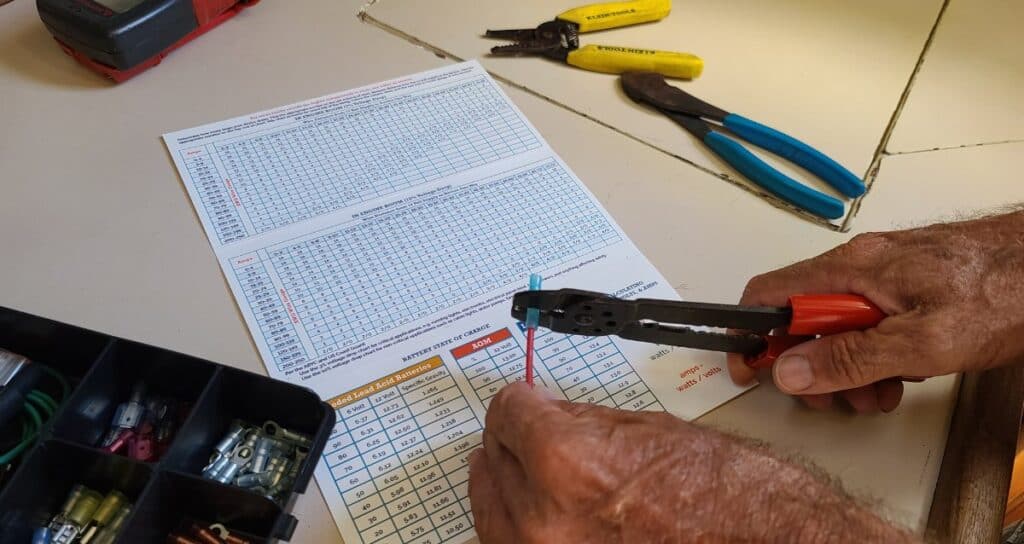
Our 12 Volt Wiring Size Chart is a waterproof, grease-proof card that lives right in the toolbox. It has voltage drop tables for both sensitive electronics and non-critical loads, separate tables for engine-room installations, and a battery state-of-charge reference. Check it before you start, and you’ll never have to guess.

Carolyn Shearlock has lived aboard full-time for 17 years, splitting her time between a Tayana 37 monohull and a Gemini 105 catamaran. She’s cruised over 14,000 miles, from Pacific Mexico and Central America to Florida and the Bahamas, gaining firsthand experience with the joys and challenges of life on the water.
Through The Boat Galley, Carolyn has helped thousands of people explore, prepare for, and enjoy life afloat. She shares her expertise as an instructor at Cruisers University, in leading boating publications, and through her bestselling book, The Boat Galley Cookbook. She is passionate about helping others embark on their liveaboard journey—making life on the water simpler, safer, and more enjoyable.
Bob Ashforth says
I also went with the approach of terminals and heat-shrink tubing, but made some different equipment choices.
This microtorch kit with multiple ends; one is for heat-shrink tubing and another for rope-cutting, which I used for my safety-net installation:
http://amzn.to/2yfzCfF
The Klein ‘all-purpose pliers with crimper; include strippers for a wide range of wires gauges, a cutter which cuts cleanly, a crimper which works well, and shearing for 6-32 and 8-32 bolt sizes.
http://amzn.to/2A1goay
Your list didn’t include any meters/testers, which I think are a necessiry. When my 25-year-old Sears multitester died, I chose this Klein kit:
https://amzn.to/3PYylg1
Thanks for all the info you put out there, hope this set of addenda helps!
Bob
Carolyn Shearlock says
Thanks Bob! My personal preference is NOT for the pliers-type of strippers, but that may be due to my lack of grip strength due to a badly broken wrist. Nice to know which ones you think work well. And I was going to put my multimeter in a separate post . . . it’s a vital piece of equipment.
Les Griffith says
If using plastic wire ties get a good set of End Cutters but make sure the blade is flat not beveled so there is not a sharp end to cut you. Better yet just use wire lacing and avoid pladtic ties for permanate installations.
John Alber says
Very helpful article.
I have used open flames in confined spaces, just like everyone else. But that’s a risk I now prefer to avoid. In gasoline-powered vessels, open flames have no place in bilges or engine rooms. And, even though we operate a diesel vessel, I still think about dust, stray propane, or other volatiles. So I use an electric heat gun. It is safer, and far less prone to char insulation.
I also prefer Ancor’s heat shrink terminals for marine work. It adds one more layer of protection to the connection, and the glue that oozes from the tubing to the wire insulation adds mechanical strength to the joint.
Paul says
Carolyn,
As always great tips, and timely since I was just going to replace a wire stripper.
I understand you (rightfully) get small compensation from Amazon when folks use your links to purchase. I personally prefer to use smile.amazon.com so that part of my purchase goes towards charity. Is there a way you can include smile.amazon.com links also? Thanks in advance.
Carolyn Shearlock says
I am sorry, but Amazon has not created a way to pass on smile links. And yes, I do get a tiny bit of compensation (at no extra cost to you) when people use my links — that’s what enables me to spend my time doing this instead of working in a local store.
Paul says
Thanks for the info … will Boat Galley link shop on Amazon and ‘personal’ shop on smile 🙂
Ernie says
Those wire strippers were in my Christmas stocking and they are the cat’s meow!
Jon M says
I just wish to confirm to the “average boat owner” that this list is a good and accurate one.
I build marine instrument panels and basically have the same equipment as listed above (different manufacturers but functionally identical). I often use a smaller size of side cutters about 4” long, with a smooth cutting edge- note that all cutters should be able to cut right up to the inner corner so as to always make clean cuts.
I also keep self-amalgamating rubber tape and dilectric grease in hand for making things watertight and corrosion proof. This stuff isn’t permanent but lasts a good few years before needing checking for degradation.
robert l waldrop says
I really appreciate this information. I am assembling a dedicated “electrical” tool box for our soon to be reality boat home, and while I have electrical experience and training, it was in relation to my military specialty, not a dedicated field. One thing I did that you didn’t mention was purchase a good multimeter – Some people prefer a test light, but I find a good multimeter is a very valuable tool either in a house, boat, vehicle etc. I already bought the exact same terminal assortment you listed, as well as the heat shrink assortment. From past experience of my own, the crimper you mentioned is definitely a must-have!
Brendan KLEIN BRETELER says
It looks like the book you are referring to Don Casey’s ‘sailboat electrics simplified’ was first published in 1999. Is there a more up to date book that you could recommend? It is this book updated to 2020 standards? I have a complete rewire to undertake and in looking for a good book to guide me through it.
Carolyn Shearlock says
I’d use a combination of Casey’s book and also get the latest edition of Nigel Calder’s. I like Casey for giving me a good overview, but Calder is much more advanced and is quite up to date. Calder’s Boatowners Mechanical and Electrical Manual, 4th Edition (2015) — see it on Amazon.
Rob Miller says
You are so right about the Nigel Caulder book, I am reading it now and am totally amazed at what I am learning. We are buying a 28 foot cruiser and this book is a must read.