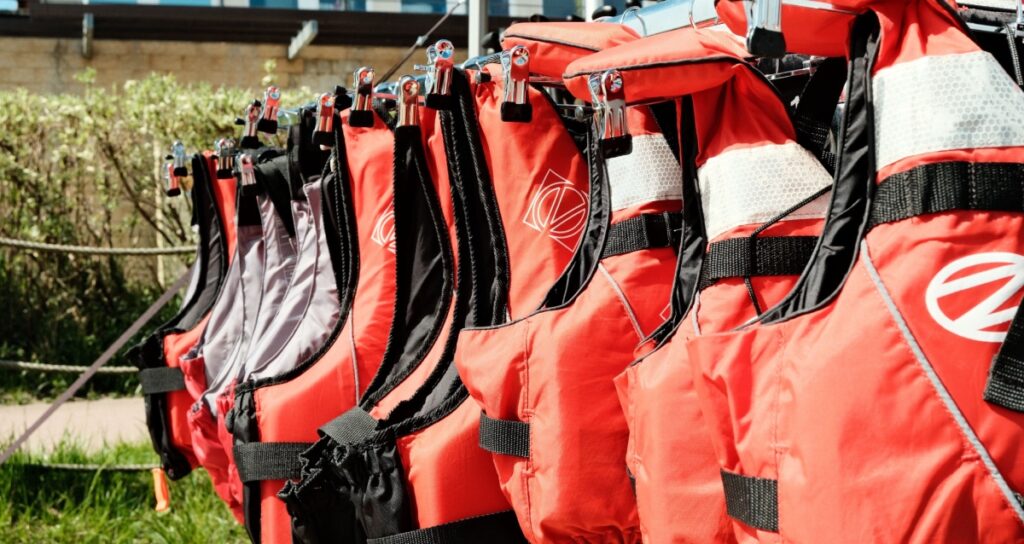
When you live and cruise aboard, you may need several types of personal flotation devices (PFDs). But do you know where to store PFDs on your boat so they’re handy when you need them and not contributing to damp conditions below? I have some ideas for you.
Different PFDs for Different Uses
The US Coast Guard requires you to carry a PFD for every human on your boat (and yes, that includes visitors). If you have pets, you’ll want to keep them safe too. But the right PFD for one use might not work for another. For example, you don’t want to wear an inflatable triggered by water when you’re learning to use your new-to-you stand-up paddleboard.
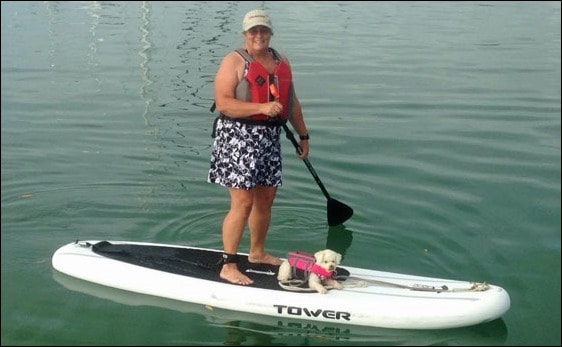
We had three sets of PFD’s aboard Barefoot Gal: our inflatable ones with integrated harnesses for use underway, cheap orange horse-collar ones that stayed in the dinghy, and the “small boat” zip-up-the-front ones that we used for paddle boarding, or if we took the dinghy out in nasty conditions.
Keeping PFDs Close at Hand
The best way to ensure you use your PFD is to keep it visible and easy to find. We kept our inflatables near the companionway door. They were easy to grab before getting underway.
The orange horseshoe for the dinghy– well, they stayed with the dinghy. Cruisers with children will always want them to suit up with a life jacket in the dinghy.
But where should we keep the ones for the SUP? We didn’t paddle board every day, so they didn’t have to be close at hand. But storing them away below caused other problems.
The Problem With PFDs Below Decks
At first, we kept our paddleboarding life vests on our guest bed. Big problem.
I soon realized that the PFDs often got wet in salt water. Even if we rinsed them and hung them to dry before putting them away, they were still putting salt on that bed. The salt would then attract water, mold, and mildew. Ugh.
Keeping up with mildew on a boat is difficult enough without adding to the problem.
When I set out on a mission to eradicate mildew and mildew attractants during a particularly humid winter, I realized that those life jackets contributed to mildew in that aft cabin.
I started looking for a better place to keep the PFDs. Everywhere I looked below decks was going to have the same problem of putting salt in the boat.
The Best Place to Store PFDs on Your Boat
If storing PFDs below is a bad idea, what’s the solution? You need them to be out of the cabin, but you want to protect them from sun damage.
Eventually, it hit me. Why not hang them under the solar panel on our dinghy davits? They would be protected from the sun for most of the day, dry out in the wind, and we would keep the salt out of the boat. All three of ours (yes, Paz had a PFD for paddleboarding) had plastic clip latches as well as zippers. To keep them secure, I simply clipped them around the stainless steel so they wouldn’t blow away. We kept them there underway on coastal hops with no problems. However, if we were going offshore or crossing the Gulf Stream, I’d remove them. We also stored them inside when bad squalls were forecast for our anchorage.
Keeping them outside 99% of the time resulted in far less salt on the bed and a lot less mildew. I was really surprised at how much less dampness was on that bed, and how much better it smelled. I washed the bedding after moving the PFDs to get the salt out of it, as well.
Added bonus: they’re easy to grab when we want them, and it was easy to hang them up when we got off the paddle board! If you’re in an area where theft might be an issue, however, you might want to tuck them into a lazarette or other hidden storage area before you leave the boat.
Other Suggestions for PFD Storage
Take a look around your boat to see what solutions might work for you. Don’t have davits? I once saw a boat with mesh pockets sewn into the underside of their bimini to hold life jackets. If you put up deck covers at anchor, you have a wide range of places to attach PFDs: the boom, standing rigging, a mast pulpit, or deck top handholds.
Once you stop storing PFDs in your boat, I expect you’ll be much happier.
The Best PFD is One You’ll Use
I started The Boat Galley to share the tough lessons I learned in years of cruising. One discovery I’d like to share is TeamO inflatable PFDs. Safety features include integrated crotch straps that don’t chafe, and technology that keeps you from being towed face down if you end up overboard. With the weight on your shoulders instead of around your neck, they’re comfortable to wear all day. It was a big improvement over the previous PFDs we used for years.
Whatever combination of safety gear you choose, keep it handy, don’t let it contribute to mildew on your boat, and use it!

Carolyn Shearlock has lived aboard full-time for 17 years, splitting her time between a Tayana 37 monohull and a Gemini 105 catamaran. She’s cruised over 14,000 miles, from Pacific Mexico and Central America to Florida and the Bahamas, gaining firsthand experience with the joys and challenges of life on the water.
Through The Boat Galley, Carolyn has helped thousands of people explore, prepare for, and enjoy life afloat. She shares her expertise as an instructor at Cruisers University, in leading boating publications, and through her bestselling book, The Boat Galley Cookbook. She is passionate about helping others embark on their liveaboard journey—making life on the water simpler, safer, and more enjoyable.
Leave a Reply