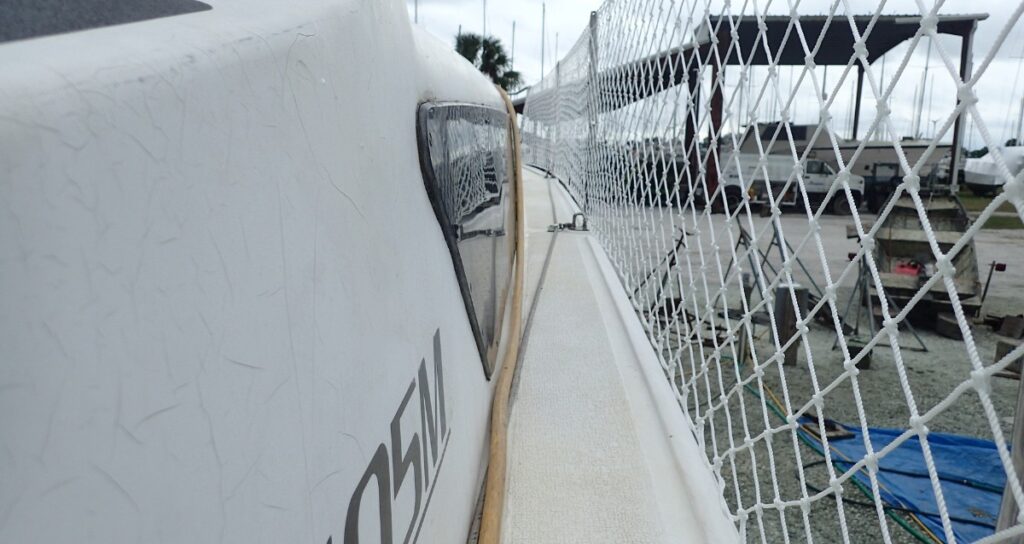
If you see a boat with netting on the lifelines, it’s a pretty safe bet that there are either kids or dogs aboard. Maybe both. Of course, netting can’t protect against all overboard accidents. But it does provide an additional layer of safety (not to mention keeping toys and tools on board).
And so after we replaced our lifelines on Barefoot Gal, we followed up by installing netting to protect our boat dog at the time, our 7-pound ball of fluff we named Paz.
Putting netting on the lifelines is one of those jobs that looks easy . . . until you start doing it. It just takes more time than you’d expect, and you have to contort your body more ways than you ever dreamed on the side decks. Consequently, even though we bought the netting a year before replacing the lifelines, we decided to wait to install netting after replacing the lifelines, so that we wouldn’t have to do it twice.
Planning to add lifeline netting to your boat? Here’s what you need to know
- the challenges of fitting it to your boat,
- how to install it, and
- where to get it.
You may even discover it’s useful for more than protecting kids and pets.
You Can’t Install it Everywhere
Each boat has unique geography. There will be places on your boat where lifeline netting just won’t work. For us, it was the bow. The way the genoa furler and the cleats for the anchor bridle (or dock lines) ran prevented it. When you plan your lifeline netting project, remember to look for these problematic areas. Will you be able to access the cleats and anchoring gear?
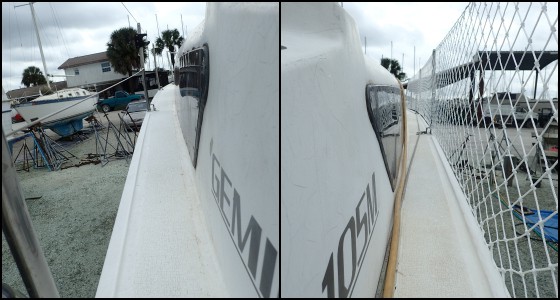
For us, the side decks were our big worry. They were fairly narrow and there was no gunwale. At anchor, Paz’s “bathroom carpet” was on the front deck. She would go up there on her own when the need arose (underway, one of us took her on her leash).
I always worry that she could slide right under the lifelines and we’d never know it. And I think she found the side deck a little scary too. She rarely walked down it, preferring to go over the cabin top instead. Of course, that was no less dangerous. She could also still fall and slide under the lifelines, but it apparently never dawned on her.
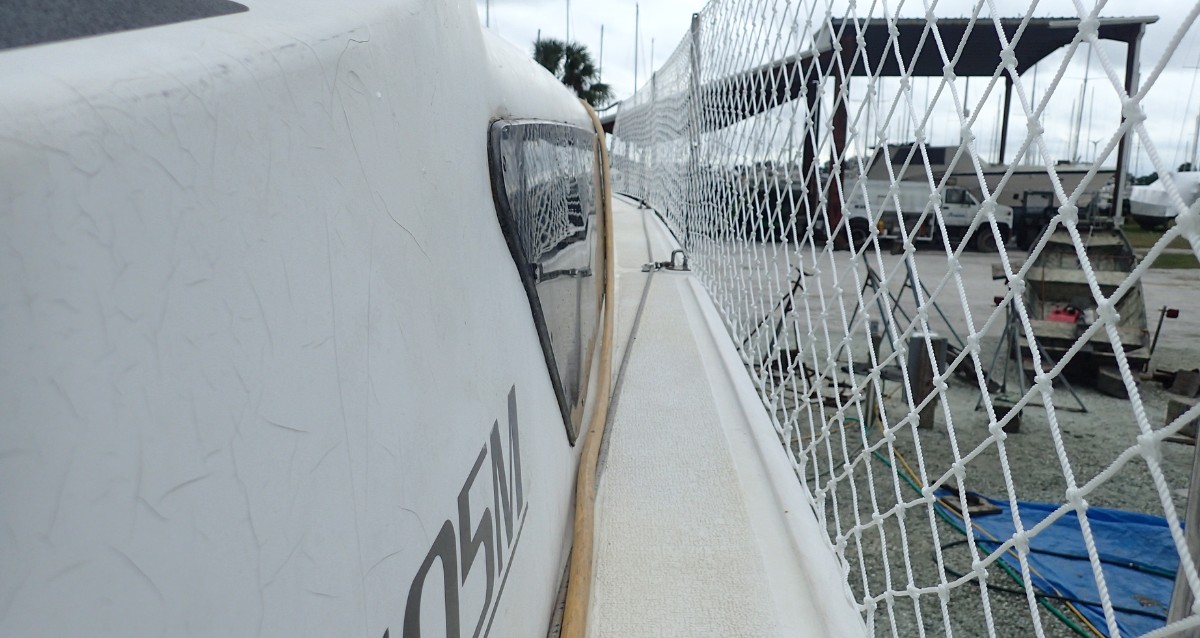
While I can never say with certainty that I knew what she was thinking, Paz seemed to appreciate the extra safety of the netting. When Dave got it pretty well strung on the starboard side of the boat, Paz walked up and down the side deck several times. Before installing the netting, she never did that. I certainly felt more comfortable than having her walk over the couch house roof.
See the side deck without the netting (left) and with it (right). It made a big difference for Paz and for us! (Note: Dave had not yet re-strung the lower lifeline in the photo on the right. That was the next day’s job.
How do You Attach Lifeline Netting on Your Boat?
There are two basic ways to attach the netting: pass the lifelines through it or attach it with cable ties or line. Dave preferred to pass the lifelines through the top and middle. He then used cable ties where it attached to the stainless tubing (the ends and a bit of the top) and to the line at the bottom. Anywhere you’ve used cable ties, you’ll need to check periodically as they will break from UV damage. Yes, even the ones with UV protectant.
Cruiser Ted A. preferred the line method instead of zip ties. He put a half hitch over the top lifelines using a shuttle made from spare cardboard. It sped up the weaving process. He made a short video demonstrating his lifeline netting method on YouTube.
How long it takes to put it up depends on several factors:
- the size of your boat
- the configuration of the lifelines, and
- the space you’re working in.
Barefoot Gal’s side decks were just a pain to work on as they’re narrow. Some “tug” owners may experience the same issue. We found we could only work about so many hours a day in such twisted positions! Dave worked on it while I did other projects. It took him the better part of three days.
Where to Buy Lifeline Netting for Your Boat
Many marine stores sell lifeline netting, and prices vary considerably. The least expensive high-quality netting that I found was at Seattle Marine, also known as SeaMar. At 60¢ – 80¢ a foot collapsed length (it shrinks by 20-35% when you pull it to its full height), it’s about one-quarter the price of many other brands. In addition, it has double strands on the top and bottom for longer life. We used this same netting on our previous boat and were happy with it.
Expect high-quality netting to last five to seven years in tropical sun; longer in temperate latitudes.
- Seamar Lifeline Netting — 2″ diamonds
- 1/8″ polyester line from New England Ropes at West Marine
- 1/8″ dacron line from Amazon
Note: even if you don’t use this line, do NOT use polypropylene as it degrades very quickly in the sun.
Shipping from Seamar can be a little slow. They tend to ship it out five days after you order, so plan accordingly. You can call and request that it go out faster. Also note that they are located in Seattle. If you opt for ground shipping, it can take five to seven days to reach Florida after leaving the warehouse.
Once you choose the height netting you need, the next page on the site tells you how to figure out how much you need as the diamonds open up.
Boat owner Donna B used sport netting (like soccer goalie netting). The company she used made netting to her specified width and length. They even reinforced the top and bottom with 1/4 inch line, a good choice for their trawler without lifelines. They chose black as it was easier on the eyes, and she claimed it lasted over ten years in the Florida sun.
I have no direct experience with sport netting, but since it’s meant to be in the sun, I can imagine it working well.
Lifeline Netting Protects More Than Kids and Pets
One of the great benefits of netting is that it keeps more than living creatures from taking an unexpected swim. Tools, toys, hats, and more can bounce off the netting and stay onboard. When you think about the cost of replacing towels, hats, and other belongings, the added cost of lifeline netting feels a little less expensive.
So show the kids and dogs how much you love them. Put netting on the lifelines!
Learn More
Learn more about all the ins and outs of having a dog on your boat with our online course, Boating With Your Dog. It gives you the in-depth details and how-to info so that you don’t have to piece it together from 50 different articles or — even harder — by trial and error.

Carolyn Shearlock has lived aboard full-time for 17 years, splitting her time between a Tayana 37 monohull and a Gemini 105 catamaran. She’s cruised over 14,000 miles, from Pacific Mexico and Central America to Florida and the Bahamas, gaining firsthand experience with the joys and challenges of life on the water.
Through The Boat Galley, Carolyn has helped thousands of people explore, prepare for, and enjoy life afloat. She shares her expertise as an instructor at Cruisers University, in leading boating publications, and through her bestselling book, The Boat Galley Cookbook. She is passionate about helping others embark on their liveaboard journey—making life on the water simpler, safer, and more enjoyable.
Leave a Reply