
Radishes keep surprisingly well without refrigeration. With one simple technique, they’ll last at least 2 weeks and often 3 to 4 weeks. For a provisioning vegetable that adds real crunch and flavor to meals when you’re far from a store, that’s a big deal.
I’ll be honest: I cruised for years before I figured this out. I always liked radishes but assumed they needed refrigeration and never bought them. Once I tried storing them unrefrigerated, I was genuinely annoyed at myself for waiting so long.
How Long Do Radishes Last Without Refrigeration?
Expect at least 2 weeks, and often 3 to 4 weeks. The cooler your storage area, the longer they’ll hold. In a warm tropical anchorage, plan on the lower end of that range. In a cooler climate, they can push past a month.
How to Store Radishes Without Refrigeration
The method couldn’t be simpler:
- Cut the green tops off just above the radish bulb. Remove the leafy tops entirely. They pull moisture out of the radish and cause it to go soft faster.
- Wash the radishes now or wait until you’re ready to eat them. Either works.
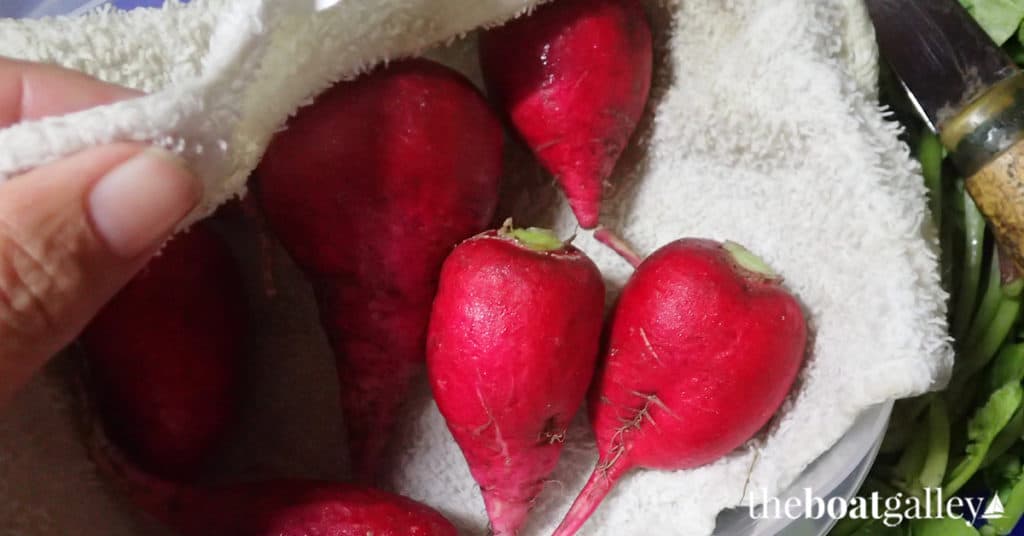
- Wrap the radishes in a damp cloth or rag and place them in an open bowl or container. Do not cover it. You want airflow.
- Every couple of days, unwrap the radishes, rinse and wring out the cloth, and re-wrap.
That’s the whole method.
One rule: don’t try to save a cut radish. Once you’ve sliced into one, use the whole thing. Cut radishes go downhill fast.
What to Do If They Start to Go Soft
Radishes lose moisture as they age, which is what makes them go limp. The fix is easy: soak them in water for an hour or so. They’ll firm right back up. Then return to the damp cloth method.
This works once or twice, but softening is a sign you’re getting near the end of their run. Use them up in the next day or two.
How to Use Radishes Aboard
The further you get from your last provisioning stop, the more you crave something with crunch and a little bite. Radishes deliver both.
I usually hold off on using them for the first week or ten days after provisioning, saving them for when other fresh produce is running low. Then I’ll use one or two a day, sliced thin, in whatever I’m making.
They’re especially good in:
- Coleslaw (a natural pairing with cabbage, another vegetable that keeps for weeks without refrigeration)
- Green bean salads
- Pasta salads
- Sliced over rice and beans
- Any salad where you want crunch and a little pepper
Buying Radishes That Will Store Well
Never-refrigerated radishes from a farmer’s market or produce stand will last significantly longer than store-bought refrigerated ones. Once a vegetable has been refrigerated, it has roughly half the unrefrigerated shelf life of produce that was never chilled.
If you can only find refrigerated radishes, they’ll still work. Just plan on the shorter end of the storage range and use them earlier in your passage.
For more on buying and storing vegetables aboard before a passage, see How to Store Vegetables without Refrigeration.
Ready to Go Further?
Radishes are just one of hundreds of foods covered in my book Storing Food Without Refrigeration. It covers vegetables, fruit, meat, dairy, eggs, condiments, and more, with storage times, what to watch for, and how to use everything well. Whether you’re managing a tiny fridge or no fridge at all, it’s the practical guide to keeping real food on board.
- Paperback from Amazon
- Paperback or PDF from our store (PDF means no shipping, start reading immediately)


Carolyn Shearlock has lived aboard full-time for 17 years, splitting her time between a Tayana 37 monohull and a Gemini 105 catamaran. She’s cruised over 14,000 miles, from Pacific Mexico and Central America to Florida and the Bahamas, gaining firsthand experience with the joys and challenges of life on the water.
Through The Boat Galley, Carolyn has helped thousands of people explore, prepare for, and enjoy life afloat. She shares her expertise as an instructor at Cruisers University, in leading boating publications, and through her bestselling book, The Boat Galley Cookbook. She is passionate about helping others embark on their liveaboard journey—making life on the water simpler, safer, and more enjoyable.
Leave a Reply