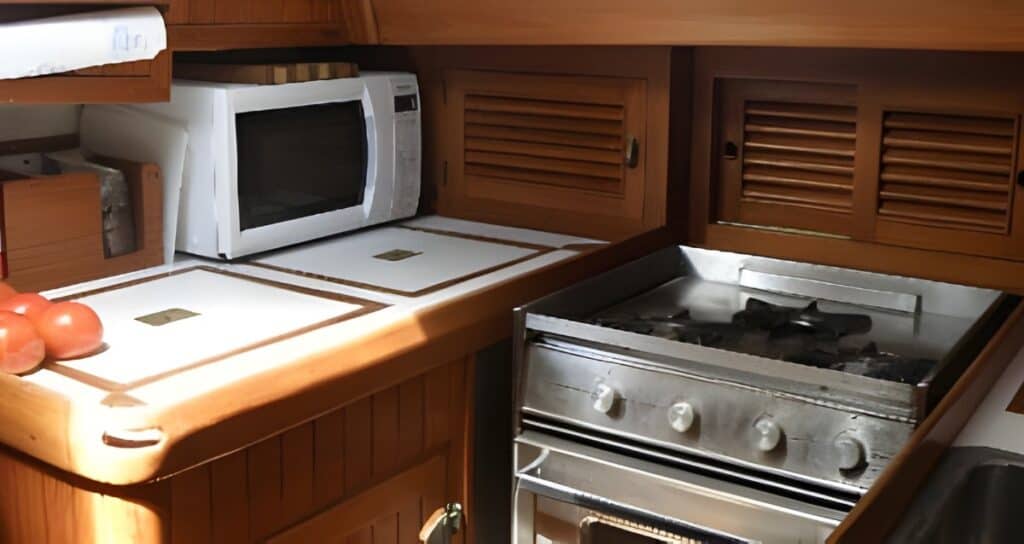
I was surprised to find a microwave on my first cruising boat, Que Tal. I never thought I’d have one while cruising. But boat owners have strong feelings about microwaves. Some can’t imagine sailing without one. Others find them a worthless waste of space and power. Should you have a microwave on your boat? I’ll let you know what to consider before you decide. These include your cruising style, available space, how you’ll use it, and your ability to power it.
Your Cruising Style
One reason it’s difficult to answer this question here is that there isn’t a “typical” TBG reader. Some readers live aboard and are prepping a boat for extended cruising. Others are currently cruising full time. Of course, there are also weekenders, part-year cruisers, and all sorts of others.
Take a good luck at your manner of cruising. Do you frequently stay in marinas? You’ll have plenty of power for a microwave tied to shore power. Do you maintain a home base where you prepare and freeze meals in advance? You might appreciate the defrost feature and ability to warm up meals quickly. If you’re planning a circumnavigation, think hard about the best use for your limited space.
Ask cruisers on similar boats to yours with comparable cruising plans for their thoughts. The owner of a large motor trawler may make different choices than someone on a 28-foot monohull.
Space
Space is probably the simplest consideration. Are you willing to give up space for something else (equipment or just storage) in order to have the microwave? Can you get power to the intended location? And how will you engineer a tie-down system to make sure that the microwave won’t go flying in rough conditions? Each of these considerations factors into the amount of space available.
Some boat owners use the microwave itself for storage: bread, for example. Does the idiosyncratic storage method justify keeping a microwave on board? One cruiser told me she used her microwave to keep her hungry canine crew member from grazing on the counter contents.
Usage
Your microwave usage ashore may or may not be a good indicator of how much you’ll use it on the boat. If you’re working (or working on the boat as opposed to cruising) and the boat is at the dock, you may find that your lifestyle is very similar on the boat to ashore. You’ll probably heat up meals, cook bacon, bake potatoes, melt butter, boil water, and so on.
The difference comes when you’re away from the dock. You may find your habits changing.
- Unless you have a large freezer, you’re not likely to have a lot of frozen meals to just heat in the microwave. Few anchorages have a store where you can just pick up something to heat up.
- Water actually boils faster in a teakettle on the stove. If you’re on passage or in a rolly anchorage, the stovetop is safer as it’s less likely to splash on you than in an open container in the microwave.
- It’s also a lot safer to melt butter on a gimballed stove than to risk hot oil sloshing in the microwave.
- In rough conditions, many cruisers love being able to “bake” potatoes in the microwave. It’s easy, you can often use the microwave when it’s too rough for the stove, and potatoes are good even if you’re mildly seasick.
- It’s also somewhat safer to cook bacon in the microwave than on the stove, particularly if it’s rolly. Just be sure to use enough paper towels to absorb the hot grease, so it won’t slosh and burn you when you remove the dish from the microwave.
- If you like popcorn (and it’s a great snack), making it in the microwave is much easier than on the stove. And at least the microwave can be used for other things, where an air popper can’t. Popcorn was BY FAR our biggest use! However, many cruisers love their Whirly Pop (Amazon) for popcorn, and it can be used as a regular pot.
- Thawing meat — well, I know I shouldn’t thaw meat on the counter. But in the tropics, a chicken breast will thaw in about 15 minutes, so I do it that way instead of thawing it in the microwave. You can also cook any meat from frozen or partially frozen. However, if you’re in a cooler climate, you might use it for thawing,
Many people find that they use their microwave as a bread box away from the dock. It’s also a good place to put small electronics during a thunderstorm (read about protecting your electronics from lightning strikes).
That said, there’s no proper way to cruise. If you believe a microwave is a necessity, then it is one for you.
Power
Yeah, this is the big one. On shore power, you have no problem as long as the boat is wired with outlets where you need them. At anchor, it means a generator or an inverter and sufficient battery and charging capacity.
Running the Numbers
A typical microwave is 1200 watts. With these, you will need at least a 2000-watt generator or a 1500-watt inverter (due to start-up loads). With a 700-watt microwave, you may be able to get by with a 1000-watt generator or inverter.
If you’re going to use generator power, keep in mind that you’ll have to run the generator every time you want to use the microwave. Most people find it impractical and end up either not using the microwave at anchor or deciding to run it off the inverter. If you’re thinking about this, you might want to read Inverters 101.
So how much battery power will it take to run the microwave? I’ll use a 1200-watt microwave as the example — the total power used by a 700-watt one is about the same since cooking/heating/thawing times are correspondingly longer.
Ignoring any losses in the system (there are always inefficiencies, but battery voltage is usually over a true 12 volts, so this works for estimation purposes), a 1200-watt microwave is going to use 100 amps at 12 volts. That’s 100 amp-hours for a full hour of use… but we just want to know how much it uses per minute since that’s how we use it. Dividing 100 amp-hours by 60 to get the amp-hours per minute gives us 1.67 amp-hours per minute of microwave use. Ten minutes is nearly 17 amp-hours.
From there, you can figure out how much you think you’d use it per day and design your power system accordingly, decide that you don’t want it, or choose to only use it when you have shore power.
Changes in Technology
I first began asking this question in 2013. A lot has changed since then. Solar power is cheaper, batteries are increasingly efficient, and so are microwaves themselves. If you choose not to cruise with a microwave now, you may want to evaluate your decision later as technology improves.
Pros and Cons
What never changes is that any choice you make on a boat has trade-offs. But when you talk to cruisers who have and love their microwaves, they highlight the following:
- generating less heat in the galley while cooking,
- secure storage inside the microwave itself,
- the ability to use the microwave as a Faraday cage,
- freeing up space by getting a microwave that functions as a convection oven and microwave,
- and, of course, the ability to make popcorn quickly (by far, the favorite use).
Boat owners without microwaves on the boat claim that a microwave:
- takes up too much room,
- you can store more stuff in the space where you have the microwave without it,
- uses too much power and,
- that you can use your oven (if you have one) as a Faraday cage.
Cooking on a Boat
Cooking on a boat is different. You will find yourself making adjustments the longer you live on a boat. That’s where The Boat Galley Cookbook can help. It’s filled with recipes and techniques that work with small spaces, rolly anchorages, limited equipment, and limited power. You can buy The Boat Galley Cookbook at our store or on Amazon, where you can get it for your Kindle as well as a hard copy.
The space/usage/power analysis is different for everyone. I know some cruisers who couldn’t imagine not having a microwave and others who gave theirs away after realizing that they didn’t use it enough to justify the space. I hope you have a better idea of what’s involved in having a microwave on your boat and whether it’s a good choice for you.
Let me know in the comments if you’re pro or anti-microwave and what kind of boat you’re cruising on.

Carolyn Shearlock has lived aboard full-time for 17 years, splitting her time between a Tayana 37 monohull and a Gemini 105 catamaran. She’s cruised over 14,000 miles, from Pacific Mexico and Central America to Florida and the Bahamas, gaining firsthand experience with the joys and challenges of life on the water.
Through The Boat Galley, Carolyn has helped thousands of people explore, prepare for, and enjoy life afloat. She shares her expertise as an instructor at Cruisers University, in leading boating publications, and through her bestselling book, The Boat Galley Cookbook. She is passionate about helping others embark on their liveaboard journey—making life on the water simpler, safer, and more enjoyable.
Leave a Reply