


The way to control mold on a boat is airflow plus the right treatment on a regular routine: keep air moving to dry things out, and clean surfaces with something that actually kills mold, like borax, white vinegar, or Concrobium. Bleach, the product most people reach for, isn’t the answer for most boat mold.
No matter what you do, plan on cleaning for mold every two to four weeks. Products that promise to prevent it entirely are designed for houses, not boats. But with the right products and a simple routine, you can keep it from taking over.
Why Mold Is Worse in Winter
Mold grows on boats year-round, but it’s at its worst in winter. In summer the hatches are open, the heat dries surfaces quickly, and air moves constantly, so it’s easier to keep up with. In winter you close everything up, condensation builds on cool surfaces, and mold thrives.
Why Bleach Doesn’t Solve It
When confronted with mold, most people reach for bleach. I did too, for years, and wondered why the mold kept coming back.
Bleach can kill mold on hard, non-porous surfaces like glass, metal, and fiberglass. But most mold on a boat is growing into porous materials: cushions, fabric, wood, headliners. On those, bleach lightens the stain but doesn’t reach the mold growing below the surface. The mold looks gone, and then it comes right back. Most wipes and “mildew stain removers” work the same way: they clean up what you can see and leave the problem behind.
What Actually Kills Mold
To kill mold and keep it from coming straight back, use one of these:
- Borax, mixed into hot water as a strong solution. It works better than vinegar, especially on fabric.
- White vinegar, straight and undiluted. Not as effective as borax, but if it’s what you have aboard, use it.
- The Practical Sailor formula (below).
- Concrobium, generally found in the paint department of hardware and big-box stores, not with the cleaning supplies, and also available on Amazon. It works well but costs far more than the others, so I save it for the places where it’s clearly better.
Don’t mix vinegar and borax. Vinegar is an acid and borax is a base; together they cancel each other out, and you end up with something weaker than either one alone.
The Practical Sailor Formula
Practical Sailor magazine tested homemade mildew treatments against commercial products, and this borax formula came out on top. Our team member Pam has been using it with good results:
- 1 quart hot water
- 2 tablespoons baking soda
- 2 tablespoons borax
- 1 tablespoon trisodium phosphate (TSP)
It costs about a penny per ounce. Apply it with a cloth or sponge, not a spray bottle; the mixture settles and clogs the nozzle.
TSP is caustic, so wear rubber gloves and keep it away from your face. It’s also high in phosphates, which feed algae blooms in harbors and anchorages. Don’t let the rinse water go overboard. Wipe surfaces down and dispose of the used solution ashore; a shoreside drain is fine, since modern wastewater plants are designed to remove phosphates.
Airflow
Treatment kills the mold that’s there. Airflow slows down the next round. You need both.
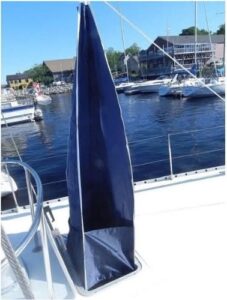
Open hatches whenever conditions allow, and run fans to keep air circulating. A wind scoop brings fresh air below so your fans move clean outdoor air instead of recirculating what’s already there. Our favorite is the Breeze Bandit 4-Way Wind Scoop, which catches wind from any direction, even as the boat swings at anchor. For more on fans and other options, see Boat Ventilation.
Keep fabric off the hull. Condensation forms on the hull, fabric soaks it up and stays wet, and mold grows right in it. That’s why many cruisers put an airflow layer under their mattress: interlocking rubber grids (Amazon), Hypervent, Dri-Dek, or the Froli System.
PortVisors let you keep ports open when it’s raining, which helps keep air moving in wet weather.
If you have shore power, a dehumidifier can help, but only if you keep the boat closed up so you’re not constantly pulling in more humid air. Friends who tried one found it wasn’t much better than good ventilation, except when the boat was in storage and nobody was going in and out.
How to Treat Each Surface
Whatever you use, wear rubber gloves. You’re protecting your hands from both the mold and the cleaning solution. Done right, treating a surface kills the mold, cleans up the black staining, and leaves a residue that discourages new growth for two to three weeks.
Hard surfaces (ceilings, floors, counters): use a rag wrung out in the borax solution, the Practical Sailor formula, or white vinegar. Go over the area two or three times until the cloth stops picking up color. Don’t rinse it off; let it dry on the surface.
Fabric and upholstery (anything that can’t go in the washing machine): use a rag wrung out in a borax solution made with the hottest water you can stand, or white vinegar if that’s what you have. Rub it in, blot it out, and let it air dry. It usually pulls out most of the black staining, too. The Practical Sailor formula works on fabric as well, but test it on a hidden spot first.
Washable fabrics (sheets, towels, clothing): wash in the hottest water possible with borax added as a booster. At anchor with no machine, boiling items in a strong borax solution on the stove works well. No borax? Use white vinegar. Even things that don’t look moldy can be harboring it, so washing every 7 to 10 days in hot water with borax makes a real difference.
The bilge: keep it as dry as you can. If you can’t, add about half a gallon of white vinegar every week or so. Skip the vinegar on an aluminum boat, though; the acid will corrode the metal over time.
Paper and books: there’s no good answer here. Store them away from the hull and anywhere drips can reach.
Tight spots (locker corners, headliner gaps, behind equipment): these get the least airflow, which is exactly where mold gets its worst grip. Concrobium spray is worth the extra cost here: you can reach places a cloth can’t, and it outperforms vinegar where there’s no air moving. It also works on the inside of a dodger.
The Locker Problem
Lockers are one of the most overlooked parts of mold control. On Barefoot Gal, I once counted 41 lockers and drawers. That number stopped me cold.
I started emptying and wiping out two a day, and got through all of them in three weeks. It made a huge difference in how much mold was hiding on the boat. Just make sure whatever you use is completely dry before you put things back.
Mold control isn’t complicated. More than anything, it takes diligence. Stay on top of it, and mold stays a nuisance instead of a crisis.
Keep Fresh Air Moving Below
Treating surfaces kills the mold that’s already there. Airflow slows down the next round, and a wind scoop is the simplest way to get fresh air below while you’re at anchor.
From The Boat Galley Store
Breeze Bandit 4-Way Wind Scoop
Keep your boat livable in hot climates with no power required
- Catches even the tiniest breeze from any direction so you get constant airflow without resetting as the wind or current shifts
- Tall, four-chamber design funnels far more air below than traditional wind scoops
- Quick to release from inside the cabin when a squall hits: no rushing on deck in the rain
- Fits hatches up to 24″ x 24″
Keep reading



Carolyn Shearlock has lived aboard full-time for 17 years, splitting her time between a Tayana 37 monohull and a Gemini 105 catamaran. She’s cruised over 14,000 miles, from Pacific Mexico and Central America to Florida and the Bahamas, gaining firsthand experience with the joys and challenges of life on the water.
Through The Boat Galley, Carolyn has helped thousands of people explore, prepare for, and enjoy life afloat. She shares her expertise as an instructor at Cruisers University, in leading boating publications, and through her bestselling book, The Boat Galley Cookbook. She is passionate about helping others embark on their liveaboard journey, making life on the water simpler, safer, and more enjoyable.
Some links in this article (including all Amazon links) are affiliate links, meaning that we earn from qualifying purchases.