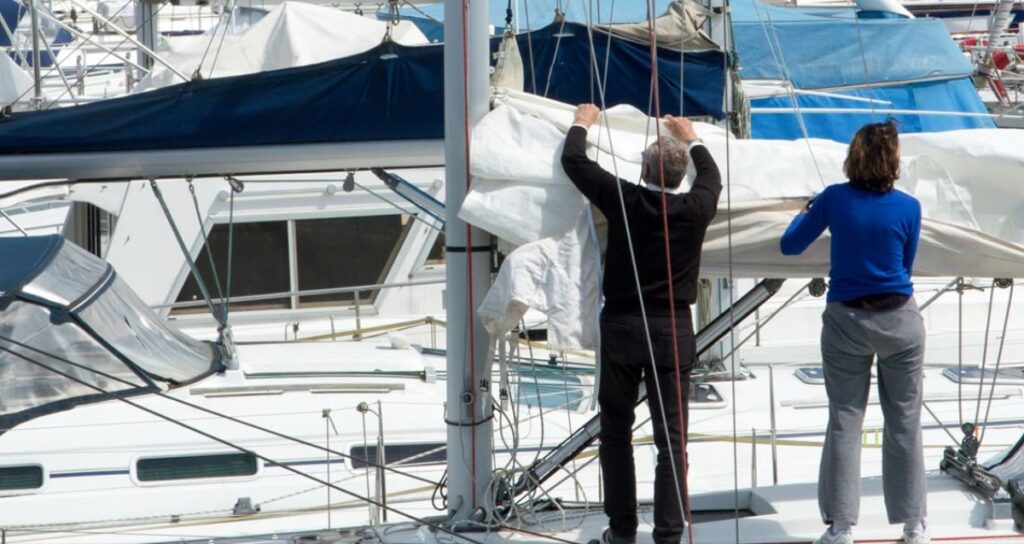
Before we bought Barefoot Gal, we walked away from a deal on another boat, stopping the survey after two hours. Why? Because the survey discovered several deal killers. But what exactly is a deal killer when you’re buying a boat? And should every boat buyer have the same list?
Keep reading to find out what kills a deal for us, what other boat owners believe are deal killers, and what it means to find the perfect boat for you.
What Kills a Deal for Us
To us, deal killers were things that could turn the boat into a money pit. Just because something is a big-ticket repair doesn’t make it a deal killer if the seller is willing to lower the price to make it work, and if you’re willing to delay using the boat while making repairs, it might work out great. To us, deal killers were:
- Anything structural or a critical system where the repair cost can’t be estimated with a fair degree of certainty. In addition, it’s a problem where we can’t determine the worst-case scenario price of repairs. For example, if a survey shows engine issues, you may not know if the problem can be repaired or what it will cost. But you could get an estimate for replacing the engine. If you don’t know the top-end number, you can’t negotiate a fair price.
- Anything where the estimated cost and renegotiated deal would take you over budget–either in money or in time. Don’t overlook the time element — how long are you willing to be without the use of the boat? Just because you can make the money work out doesn’t necessarily mean you should take on a major project! And some boats and projects will take you over your budget even if you got the boat for free . . .
- Anything that you’re just not sure could be fixed properly, or where you’re told “we’re just not sure what’s causing that.” These, in particular, are the things to run from!
When we began looking at boats, we had decided that while we might be willing to take on a few small, well-defined projects to make an almost-perfect boat into the perfect one, we didn’t want any major projects. We didn’t want to lose a year of cruising (or more). And we certainly didn’t want to spend an entire season in a boatyard. Worst of all, we didn’t want to spend weeks or months overseeing a refit or repair from 1500 miles away.
Finally, we didn’t want a boat where we couldn’t estimate the cost of necessary repairs because “we can’t tell what has to be done until we tear it apart.” That sounded too much like a bottomless money pit to us.
Deal Killers are Personal
I hope the general principles I’ve shared about our process help you. In the end, however, deciding not to buy a boat depends on your unique circumstances and comfort level.
A marine diesel technician might think nothing of repowering an engine if everything else looks good. Others might find the thought of replacing chain plates embedded deep in fiberglass more intimidating. Your previous experience and knowledge base determine what’s a deal killer for you.
Your cruising plans will also affect whether you go through with a deal or not. For example, a cruiser buying a boat in the eastern United States who plans to head to the Mediterranean will want to be sure every system is in good shape before crossing an ocean. A coastal cruiser, taking their time, will have more opportunities to do work a little at a time.
It can be nerve-wracking to make such a big purchase. That’s why we shared tools like the Boat Comparison Spreadsheet and New Boat Checklist in our From Dreamer to Cruiser course (available as a standalone course, or as part of the All-Access Pass).
Of course, other boat owners and cruisers can share a wealth of knowledge as well.
Boat Owner’s Advice
So, what are other perspectives on when you should decide not to buy a boat?
Chris suggests doing a search to make sure the title of the boat you’re buying is actually clean. If an owner stops making payments on their boat loan and tries to title it in a new place, you could find yourself owning a boat that is actually stolen property.
In addition, Chris shared a deal breaker with many boat buyers: Boats that have sunk and been refloated. You’ll often find this situation with hurricane boats. Mold can be growing on wiring and in hard-to-reach areas, and you’ll never get rid of it.
Cruiser Dick reminds us that it’s not only the condition of the boat that can be a deal killer. If an owner doesn’t seem interested in selling and is hard to reach (or, conversely, if they’re especially desperate to sell without an obvious reason), think carefully. You want a transaction to have parity between the buyer and seller.
Deb’s purchasing experience benefited from asking the seller for any old surveys he had. The old survey identified damage that the current owners didn’t address. If the seller is willing to provide this information, it can help you determine if you should walk away from a boat before spending money on your own survey.
In addition to surveys, there are other helpful sources of information. Chris recommends asking a seller if the vessel has ever been subject to an accident or an insurance claim. If you already have an insurance agent, they may be able to provide this information for you. Even asking the seller may yield helpful details and cause them to think carefully before they reply.
The Best Boat for You
In the end, the boat you decide to buy is unlikely to be perfect. It just has to be perfect for you. Thinking ahead of time about what deal killers make you like to not buy a boat you’re looking at should save you hours of worry and potentially thousands of dollars.

Carolyn Shearlock has lived aboard full-time for 17 years, splitting her time between a Tayana 37 monohull and a Gemini 105 catamaran. She’s cruised over 14,000 miles, from Pacific Mexico and Central America to Florida and the Bahamas, gaining firsthand experience with the joys and challenges of life on the water.
Through The Boat Galley, Carolyn has helped thousands of people explore, prepare for, and enjoy life afloat. She shares her expertise as an instructor at Cruisers University, in leading boating publications, and through her bestselling book, The Boat Galley Cookbook. She is passionate about helping others embark on their liveaboard journey—making life on the water simpler, safer, and more enjoyable.
Carolyn Shearlock says
Great idea on the past surveys. We had gotten the previous one, but it was 8 years old.
Summer says
We are in the market for a survey. Please share names and numbers.
Deb Lewis says
Not sure where you are located but if on the east coast or the Carribean, give them a shout. Happy to recommend Johnson Marine Services. Capt Ken Johnson did our survey. Here’s a link to their website: http://www.johnsonmarineservices.com/
Deb Lewis says
As you probably know, a pre purchase survey and an insurance survey are different animals. While your insurance company may have a long list of surveyors with whom they work, it might be a good idea to get other recommendations as well and if you come up hearing the same name from both sides, you’ve probably found a winner.