

To deep clean a boat interior, go after the places routine cleaning never reaches: under the floorboards, around the stove, under the refrigerator, beside the water tanks, and inside lockers you rarely open. Dirt, grease, and moisture build up there for years, and that’s usually where a musty boat smell comes from.
You won’t know how bad it is until you look. We didn’t.
What We Found Under the Floorboards
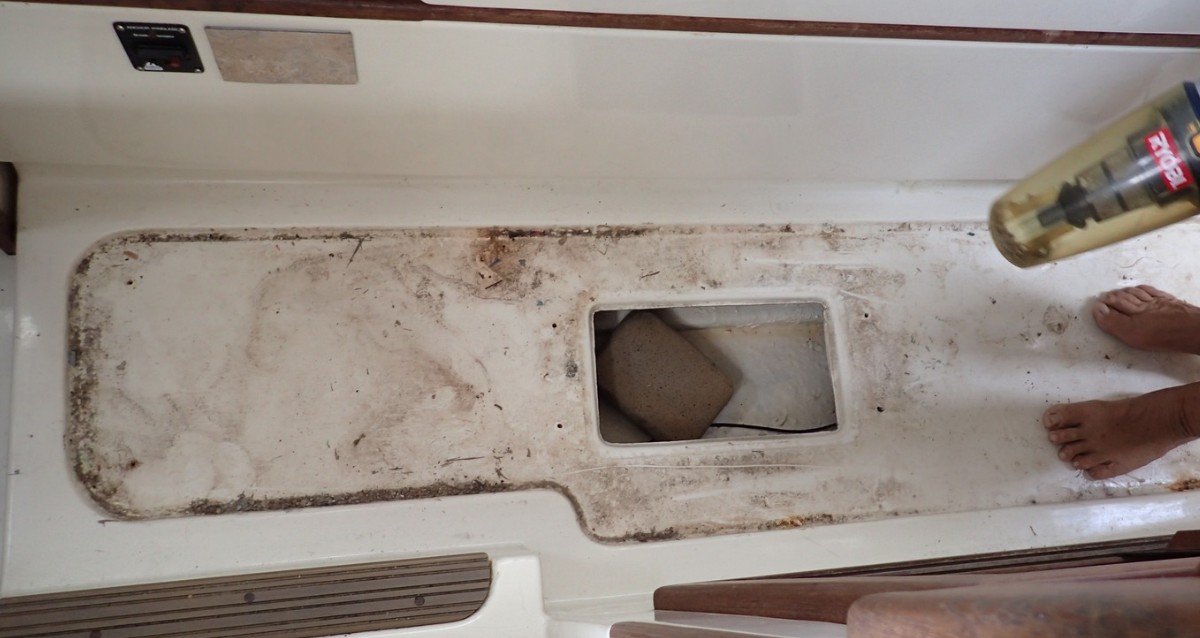
In 2015, a partial bucket of water spilled on the floor of Barefoot Gal, and Dave noticed that a lot of it disappeared into the seam between the fiberglass floor and the teak and holly overlay. He unscrewed the wood and lifted it to wipe up the water.
Yikes. Sixteen years of dirt, grime, and mold had collected under there, and the back side of the wood was the worst. The photo at the top shows what was left on the fiberglass when the board came up.
We pulled up every floor section, and every one was gunky. Where there was just dirt, we vacuumed it up and washed the fiberglass. Where there was mold, we treated it (bleach isn’t the answer; see what actually kills mold on a boat) and let the wood dry thoroughly before putting it back down.
Then we sealed it. A friend on another Gemini had watched a spilled Coke vanish under his floorboards. When he put his boards back, he set each screw in silicone and ran a thin bead of silicone around the edge where the wood met the fiberglass. We did the same, and it worked. It held until we replaced a couple of the boards years later for other reasons. Silicone isn’t very adhesive, so the old boards still came up easily, and we sealed the new ones the same way.
If you see a spill disappear into a seam, lift the board and look.
Why a Boat Gets So Dirty
Living on a boat is dirtier than living in most houses, and it isn’t your imagination.
- The hatches are open. In a house with air conditioning, outside air gets filtered. On a boat, hatches and ports are open most of the time, often without screens, and dust blows right in. In the Caribbean, some of it is Sahara dust carried across the Atlantic.
- You track it aboard. Cruisers walk more ashore than they did at home, and sand and dirt come back on feet, legs, clothes, and pets.
- You sweat more. Without air conditioning, everyone sweats, and sweat, skin, and hair end up in cushions, rugs, and bedding.
- It’s concentrated. Our living space on the boat was about half the size of our 750-square-foot house. The same dirt in half the space looks like twice as much.
On older boats, crumbling foam behind the headliner can add a fine rain of dust, too.
All of it settles into corners, seams, and low spots, which is why those places need deep cleaning.
The Hidden Spots to Deep Clean
Around the Stove
This was the worst spot on our boat, and around the stove it’s nothing but grease. Food bits and spatters fall into the gap between the stove and the counter or bulkhead and bake on. Besides being gross, it attracts roaches and other critters.
Krud Kutter is the best degreaser I know. It’s non-toxic and biodegradable, with no bleach or ammonia, which matters when everything ends up in the water. Spray it on full strength, let it sit briefly, and scrub; on textured surfaces, a nail brush or toothbrush gets down where grease hides. Don’t use it on varnish or leather. It’s also great on the grime that builds up around door handles, latches, and switches.
To reach into the gap, tape a bottle brush to a dowel or a long knife. Readers have also wrapped a towel around the end of a sail batten and secured it with zip ties. Spray the cleaner on the brush or towel and scrub back and forth.
I cleaned the stove gap and behind the stove about once a week on both boats. Once a year or so, we pulled the stove out completely for a really thorough cleaning. It’s a pain, which is why it’s only once a year, but your owner’s manual will show how to remove it.
Under the Refrigerator
The refrigerator’s fan pulls in air, and with it a lot of dirt, which settles underneath and around the unit. Vacuum there regularly, along with the fan, coils, and vents. Clean coils also help the fridge run more efficiently.
Next to the Water Tanks
There was a lot of dirt beside our water tanks. As far as we could tell, no one had ever cleaned there. Tank spaces are closed in and rarely opened, so dirt drifts in and just stays. Vacuum it out, then wipe the area down.
Hoses
Every hose on the boat collects dust and grime, and it doesn’t just sit there; it sticks. Water lines, drain hoses, and any others you can reach all need a wipe-down. Spray a rag with Krud Kutter and run it along each hose, and use a nail brush on ribbed hose where the grime packs into the grooves.
The Locker Behind the Toilet
This one had both dirt and mold. The head is the dampest area on most boats, and a locker behind the toilet gets little air. Empty it, vacuum it, and treat any mold with borax or white vinegar. Let it dry completely before you put anything back.
Other Lockers and Under the Mattress
Any locker against the hull, and the space under your mattress, collects condensation, dust, and eventually mold. Work through the lockers a couple at a time rather than all at once.
Wash Rugs and Throw Pillows More Often
Rugs, throw pillows, and cushion covers soak up everything above: dirt, sand, salt, and sweat. Wash them more often than you would in a house on land. Anything that can go in the washing machine should go in regularly, and rugs should get a good shake outdoors between washes.
Tools That Make Deep Cleaning Easier
- A cordless handheld vacuum for corners, seams, and lockers. After going through a string of cheaper ones, we splurged on a much more expensive Dyson. It worked far better and ended up costing less per year of use.
- Krud Kutter for grease (Krud Kutter on Amazon).
- Borax or white vinegar for mold. Mold and Mildew on a Boat explains how to use them on each surface.
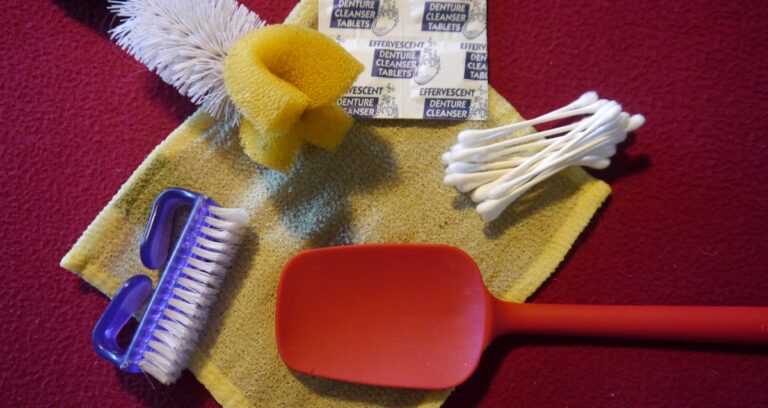
- A bent toothbrush for tight crevices. Hold the handle over a flame for about five seconds until it softens, then bend it and hold it until it cools. Do it over the sink: the first time I tried, I held the toothbrush too close to the flame and the handle caught fire. For even smaller spots, a baby-bottle nipple brush works well.
- A bottle brush or towel on a long handle for the stove gap.
For a complete list of what I kept aboard, see Cleaning Products for a Boat.
Keep the Gunk From Coming Back
Once you’ve cleaned the hidden spots, you can keep them from getting bad again:
- Clean the stove gap weekly.
- Vacuum under and around the fridge monthly.
- Seal floorboard seams with silicone.
- Check the tank spaces and back lockers a couple of times a year.
Spring Cleaning in the Galley covers the bigger seasonal galley job, and Quick Tips to Keep Your Boat Clean is about keeping dirt off the boat in the first place.
You won’t ever have a spotless boat, and you shouldn’t try. There’s too much fun stuff to do. But a deep clean of the hidden spots now and then keeps the gunk, and the smell, from taking over.

Free from The Boat Galley
The Boat Galley Newsletter
Free, every Wednesday. Unsubscribe anytime.
Keep reading


Carolyn Shearlock has lived aboard full-time for 17 years, splitting her time between a Tayana 37 monohull and a Gemini 105 catamaran. She’s cruised over 14,000 miles, from Pacific Mexico and Central America to Florida and the Bahamas, gaining firsthand experience with the joys and challenges of life on the water.
Through The Boat Galley, Carolyn has helped thousands of people explore, prepare for, and enjoy life afloat. She shares her expertise as an instructor at Cruisers University, in leading boating publications, and through her bestselling book, The Boat Galley Cookbook. She is passionate about helping others embark on their liveaboard journey, making life on the water simpler, safer, and more enjoyable.
Some links in this article (including all Amazon links) are affiliate links, meaning that we earn from qualifying purchases.