
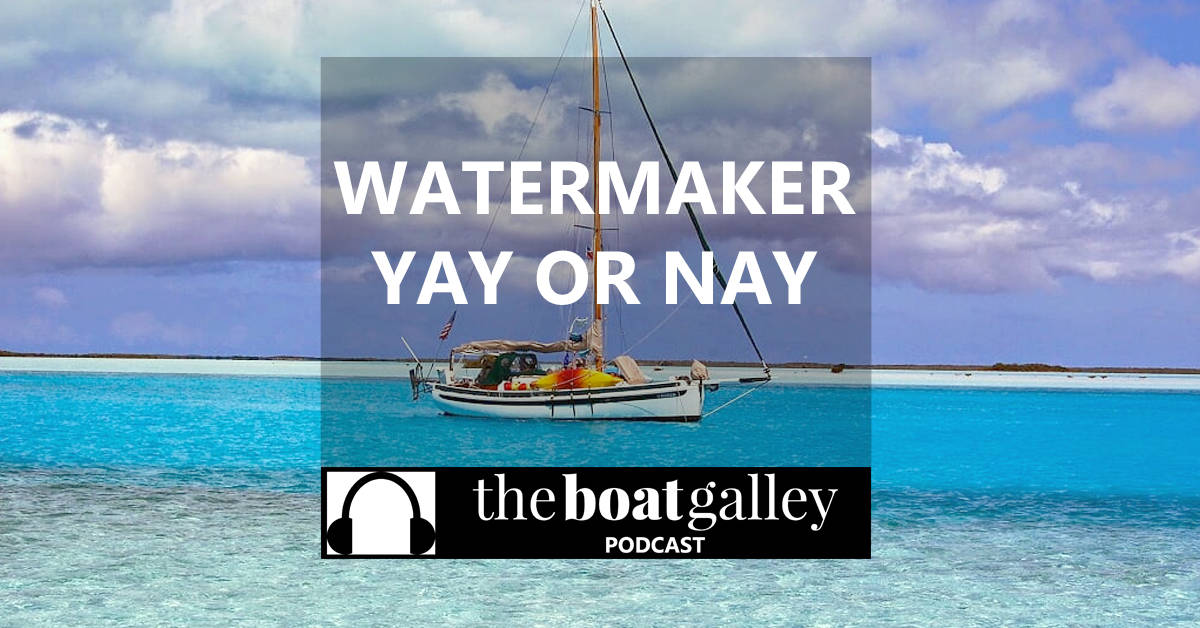
Do you need a watermaker? Nica cruised three years without one and a year with one, and her answer is: it depends. Here are the questions she suggests asking yourself.
Questions to Ask Before Buying a Watermaker
- Do you need one? No. People cruised for years before watermakers existed.
- What’s your budget? Units can top $10,000, plus installation, power, and maintenance. For one winter in the Bahamas, buying water is far cheaper.
- How long will you cruise? $10,000 over six months is very different from $10,000 over ten years.
- Where are you going? Near towns and fuel docks, water is easy to find; in remote places like the Sea of Cortez or the Pacific, it isn’t. Dirty harbors can ruin membranes.
- How much do you carry and use? Bigger tanks mean longer between fill-ups. A big crew, a baby in cloth diapers, or pressure water all use more.
- Nica’s take: they wouldn’t have bought one, but after cruising with one, they won’t go without again.
Links:
Rigid water jugs (Scepter 5-gallon) (Amazon)
Collapsible water container (Amazon)
Prefer to read? Check out Watermaker Yay or Nay?
The Podcast Has Wrapped Up
We’re no longer recording new episodes, but all 820 are still available. Listen right here, or find them on Apple Podcasts, Spotify, Alexa, or any podcast app (search for “The Boat Galley”). To keep getting a weekly dose of real cruising life (boat projects, provisioning, passages, and the day-to-day of living aboard), sign up for our newsletter. It comes every Wednesday.
Free from The Boat Galley
The Boat Galley Newsletter
Free, every Wednesday. Unsubscribe anytime.

Sponsor: Rainman Watermakers and SeaTask. Rainman watermakers are capable of producing up to 37 gallons of fresh, clean drinking water per hour from seawater. Portable and installed models are available, all with off-the-shelf parts. Configurations are available in AC, 12 Volt DC, and even a gasoline system, with new 2019 models being smaller, lighter, and quieter than ever. Seatask is the premier US facility for Rainman watermakers – visit them at www.seataskgroup.com to learn more!
Music: “Slow Down” by Yvette Craig

Keep reading

Some links in this article (including all Amazon links) are affiliate links, meaning that we earn from qualifying purchases.