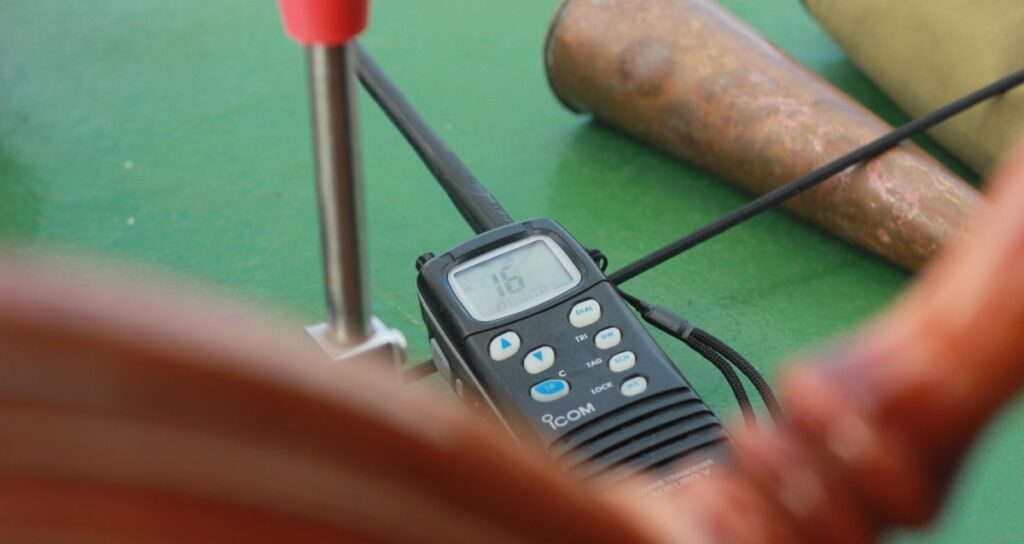
VHF radio has many benefits for cruisers. Yes, they keep us safe. They facilitate us getting help. But they’re also the social core of the cruising world. Nothing taught us that more than when we were going through the coronavirus lockdowns.
How VHF Radios Keep us Safe
Some boaters take their radios for granted. But they are wonderful little devices that do so much for us. And no, they aren’t obsolete, even with cell phones and satellite radio.
VHF radios connect us when other methods don’t work. We’ve sailed and traveled in remote areas with no cell coverage. There are even cell phone dead zones in the relatively dense coastal United States. And sunspots or even hacking can render satellite phones unusable. If you find yourself needing help in one of those situations, you’ll rely on your VHF radio, not your cell phone.
Obviously, weather alerts are crucial underway. During thunderstorm season, you’ll be glad for your VHF radio letting you know when a waterspout has been spotted nearby.
When you need help in an emergency, both the Coast Guard and nearby boaters are close at hand when you call on your radio. And if you can’t call, you can rely on your automatic DSC alarms. Many radios also act as AIS receivers, making navigation in crowded waters or at night just that much safer.
How VHF Radios Keep us Connected
Yes, cruiser’s nets are a wonderful way to keep up with what’s happening in your anchorage. Instead of talking to a single person, you can connect with several at once. During the COVID lockdowns, evening seminars, chats, and trivia contests kept us entertained and connected.
In normal times, they share social occasions you might otherwise miss out on. And as John Herlig points out in the course, VHF Radios: Everything You Need To Know, if you are cruising with children aboard, they are a great way to find other boats with kids. Nets are also an effective tool to meet neighbors in general and to get tips and tricks for the local area—what time the fuel dock opens, which day, and where trash gets picked up.
And of course, there’s the common habit of eavesdropping on other radio calls. Ask any cruiser about their favorite overheard radio conversation, and you’ll get some hilarious stories. Yes, that means don’t say anything on the VHF radio you wouldn’t want to have heard by a stranger.
If you’re new to living on a boat or cruising, you might not know what your VHF can do for you. It’s far more than just a glorified walkie-talkie, and your cell phone is no substitute.
Knowing how to use your VHF is critical to staying safe on the water! It even makes cruising more fun.
You Might Also Be Wondering About . . .


Carolyn Shearlock has lived aboard full-time for 17 years, splitting her time between a Tayana 37 monohull and a Gemini 105 catamaran. She’s cruised over 14,000 miles, from Pacific Mexico and Central America to Florida and the Bahamas, gaining firsthand experience with the joys and challenges of life on the water.
Through The Boat Galley, Carolyn has helped thousands of people explore, prepare for, and enjoy life afloat. She shares her expertise as an instructor at Cruisers University, in leading boating publications, and through her bestselling book, The Boat Galley Cookbook. She is passionate about helping others embark on their liveaboard journey—making life on the water simpler, safer, and more enjoyable.
Leave a Reply