Moving Aboard a Boat: How to Organize the Move
When you move aboard a boat, almost everything you own has to go to one of four places: with you, onto the boat, into storage, or out the door. Getting each item to the right place, the first time, is the whole organizing challenge.
It sounds simple. It isn’t. You don’t actually sell everything, and the moment you start sorting, you realize how many decisions are hiding in a houseful of stuff.
You Don’t Really Sell Everything
Some things you’ll need every single day right up until you step aboard. Some go on the boat. Some go into storage. Some get handed to family or friends, and some get sold or donated. That’s six destinations, more if you count each friend or family member that gets something, and every box, bin, and bag belongs to one of them.
The job gets harder when the boat is far away. Ours have been hundreds, even thousands, of miles from the house we were leaving. It gets harder still when you’re not going straight from the house to the boat. We’ve stopped to visit family on the way, which meant some boxes had to travel with us and be given to them before we ever reached the water.
So the real question isn’t “what do I get rid of.” That’s a separate job, and if you’re still wrestling with it, start with how to actually downsize a house full of stuff. The question here is the one that comes after you’ve decided: how do you keep six destinations straight while you pack, store, and move it all?
The Six Destinations
Before you tape up a single box, get clear on where things can go. For us, the six were:
- With us. The things we needed in hand right up to departure, and on the road if we were traveling first. Extra checkbooks, medicines, the dog’s supplies. These lived in a corner of our bedroom, never in the storage pile.
- The boat. Everything actually moving aboard but that we didn’t actually need as we were packing or on the road.
- Storage. What we were keeping but not taking on the boat, like camping gear for a land trip or winter clothes for a Christmas visit to the kids.
- Sold.
- Donated.
- Given to specific people.
Naming the destinations first is what makes everything after it work. Once every item has an obvious home, packing stops being a series of agonizing decisions and becomes simple sorting.
How We Started, and Where It Went Wrong
We began by renting a storage unit near the house. The long-term plan was to move that storage to Florida eventually, where it’d be closer if we needed something. But at first, that one unit was holding three different destinations at once: things for the family we’d visit near the boat, things for the boat itself, and things staying in storage. I was trying to keep each destination grouped together so we could eventually load a trailer with some kind of logic.
At first I just labeled each box with a marker. Boat. Storage. Keith. John David. Easy enough, I thought.
It wasn’t. A few boxes ended up in the wrong section of the unit. Worse, our keep-with-us financial file, the one with checkbooks and important papers, somehow landed in the to-be-stored pile. That’s the kind of mistake that turns a stressful move into a panicked one. I needed something I could read at a glance, from across a room, while distracted and tired. A marker scrawl wasn’t it.
My Best Organizing Hack: Color-Coded Tape
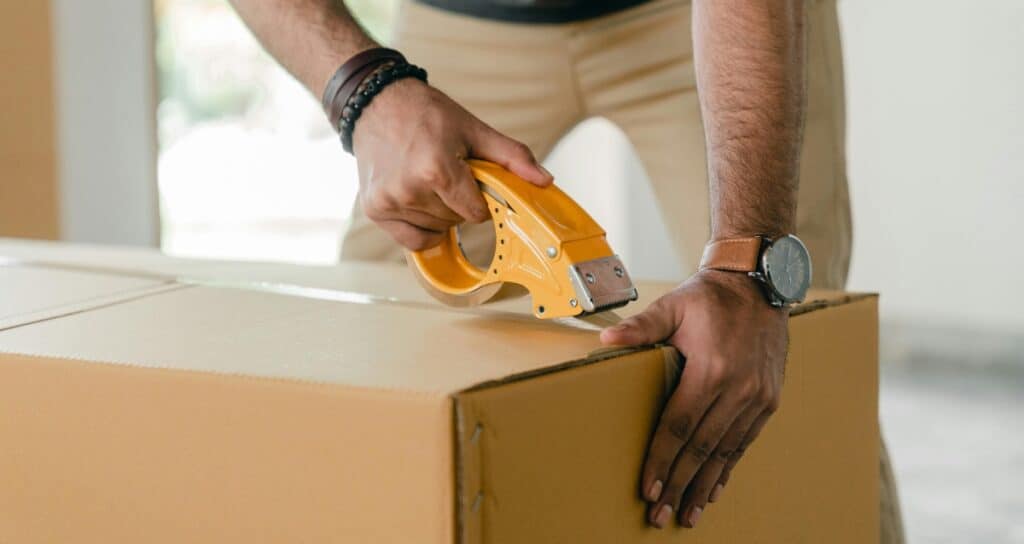
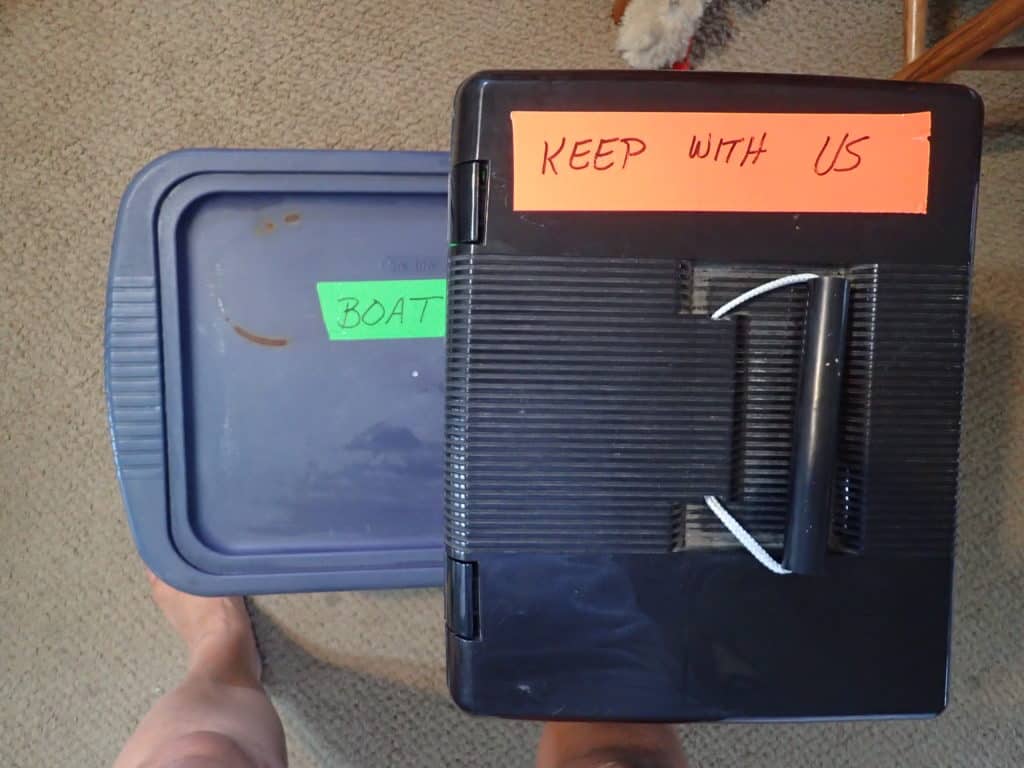
Color-coded duct tape labels were the answer. A strip of colored tape on every box told us its destination instantly, no reading required.
I bought several rolls in bright, deliberately unalike colors: bright orange, lime green, and chrome. Nothing that could be confused in dim light, so no green-and-blue or pink-and-orange pairings that blur together at dusk in a half-lit storage unit. Then I assigned each color a destination:
- Orange for keep-with-us
- Green for the boat
- Chrome for friends and family
- Clear tape for boxes simply going into storage
Items to be sold or donated were taken to their destinations every few days and never went to that intermediate storage.
I still wrote the destination on the tape too, as a backup. You can find colored duct tape at most home improvement and hardware stores, or order it online. A 15 or 20-yard roll of each is usually plenty:
- Bright orange duct tape (Amazon)
- Lime green duct tape (Amazon)
- Chrome duct tape (Amazon)
Was it overkill? Maybe. We could have just read the label written on the box. But with everything else going on during a move aboard, we were tired and distracted, and anything that made one decision automatic was worth it. My advice: make this as easy on yourself as you possibly can. You’ll have plenty of hard things to deal with. Knowing which box goes where shouldn’t be one of them.
Getting the Storage Unit Right
If a storage unit is part of your plan, two things I learned are worth passing on.
First, rent more space than you think you need, by about fifty percent. It feels wasteful when you sign the lease. It isn’t. The extra room lets you walk around, pull a box from the back without unstacking the whole front, and re-sort when plans change. A unit packed wall-to-wall is a unit you can’t actually use.
Second, think about what the storage conditions will do to your things. When we looked at units in Florida, fellow cruisers there steered us toward two upgrades worth the extra money: a climate-controlled unit, which protects against the mold and mildew that thrive in heat and humidity, and an interior door rather than an outside roll-up, which is far less likely to be damaged in a tropical storm or hurricane. If you’re storing somewhere cold instead, ask yourself whether freezing would hurt anything you’re leaving behind. Our things survived numerous Illinois winters and summers in storage just fine, but it depends entirely on what you’re storing.
There’s one more storage insight I didn’t appreciate until later. If your house sells fast and you end up putting more into storage than you meant to, don’t despair. One thing a year of living without those items teaches you is how little you actually missed them. When you finally go back and clear out the unit, a lot of what felt impossible to part with suddenly feels easy to let go. Time creates an emotional distance that’s hard to manufacture any other way. If you can afford to let a storage unit ride for a while, that distance can do some of your hardest sorting for you.
A Tool That Keeps Working Long After the Move
Some people sort best with a spreadsheet, and there’s a good case for it. Pamela Douglas, a member of The Boat Galley team who created our course From Dreamer to Cruiser (available on its own or as part of the All-Access Pass), built one to manage a major downsizing sale.
She listed every item in the house, from furniture to books, then added columns to track what was for sale, what was going into storage, and what was moving onto the boat. She used it to print price tags and keep her sale organized. After the sale, she repurposed the very same spreadsheet, this time listing every locker on the boat and what lived inside it. Searching for “spare batteries” or “impeller forceps” later saved her a lot of grief digging through lockers. The tool she built to organize her move kept earning its keep for years aboard.
That’s the kind of thing worth doing once and using forever. If a spreadsheet fits how your brain works, build it during the move and it’ll still be serving you long after you’ve cast off.
Don’t Make It Harder Than It Has to Be
Living aboard and cruising is challenging, and honestly, that’s part of why so many of us love it. But the move itself doesn’t need to add to the pile of hard things. Get clear on your destinations, give yourself a way to tell them apart at a glance, and pick whatever system, colored tape, a spreadsheet, or both, makes the sorting automatic. A few rolls of tape and a little structure up front can make moving aboard a boat a whole lot less stressful, and get everything where it belongs the first time.


Carolyn Shearlock has lived aboard full-time for 17 years, splitting her time between a Tayana 37 monohull and a Gemini 105 catamaran. She’s cruised over 14,000 miles, from Pacific Mexico and Central America to Florida and the Bahamas, gaining firsthand experience with the joys and challenges of life on the water.
Through The Boat Galley, Carolyn has helped thousands of people explore, prepare for, and enjoy life afloat. She shares her expertise as an instructor at Cruisers University, in leading boating publications, and through her bestselling book, The Boat Galley Cookbook. She is passionate about helping others embark on their liveaboard journey—making life on the water simpler, safer, and more enjoyable.
Leave a Reply