
The fastest way to stop halyards from clanking against the mast is to get them far enough away from the mast that they simply can’t reach it. Tightening them doesn’t work — it just changes the pitch of the clank.
I’ve dealt with this on our Tayana 37, our Gemini 105, and on charter boats up and down the coast. There are four reliable methods. One of them will work on your boat.
A note before you start: if you have external halyards, both ends may need to be led away from the mast. Internal halyards typically only need the lower end dealt with.
And beyond the annoyance factor — clanking halyards wear faster. Every time a halyard slaps the mast, it’s chafing. Quiet halyards last longer, which means fewer replacements. (When you do need to replace one, here’s how to install a new halyard without going up the mast.)
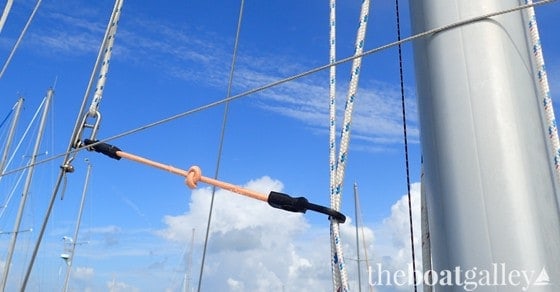
Method 1: Bungee Cords to the Sidestay
This is the fastest fix and the one I reach for first. Slack the halyard a bit, hook one end of a bungee cord onto it, and hook the other end to the sidestay. If the bungee is too long to really pull the halyard off the mast, tie a knot in it to shorten it. You can also wrap the bungee around the sidestay and hook it back onto the halyard.
If you have two halyards to quiet, you can bungee them together rather than running two separate cords to the stay.
A few things to know about bungees on a boat:
- The mini bungee cords are handy for a lot of things aboard, but they’re not strong enough to hold halyards off the mast. Use full-size cords.
- In the sun, bungees last six months to a year. Buy a jar of assorted sizes so you always have what you need on hand. Jar of 24 assorted bungee cords with hooks (Amazon)
- In a pinch, a piece of line works the same way — just takes longer to rig and un-rig.
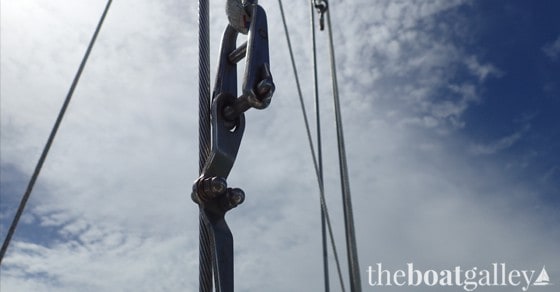
Method 2: Shroud Cleat on the Sidestay
If you look closely at the photo above, you may have spotted a shroud cleat — a small cleat or fitting mounted directly on the sidestay. These are usually meant for cleating off flag halyards, but they work perfectly for keeping any halyard off the mast. Most have an eye at the top you can clip the halyard shackle to directly.
Tighten the halyard after clipping it so there’s no slack left to slap.
Amazon sells lightweight nylon and plastic shroud cleats (Amazon) at a reasonable price. We preferred the stainless shroud cleats from C. Sherman Johnson, available at West Marine — comparable price, but significantly better quality and durability in the marine environment.
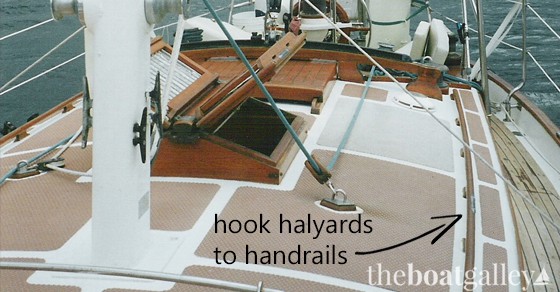
Method 3: Hook to Handrails
If your halyards are long enough and you have handrails in the right position, wrap the halyard around the handrail and clip it back to itself. Then tighten the halyard to take out any remaining slack. Simple, no extra hardware needed.
This one depends entirely on your boat’s layout — on some boats it works perfectly, on others the geometry just isn’t there.
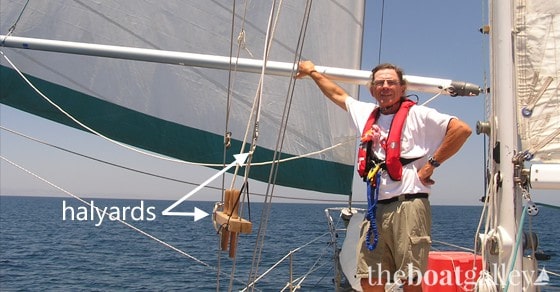
Method 4: Belaying Pin Rack
On our Tayana 37, we had a traditional rack of belaying pins mounted on the shrouds — and they were perfect for this. Depending on the halyard length, you can wrap the halyard around the pins and clip it back on itself, or make a small loop from a separate piece of line around the bar and clip the halyard to that. Either way, tighten the halyard afterward so there’s no slack to move.
Belaying pin racks are most common on older, classic-style boats. If yours has them, consider them a built-in solution.
Be a Good Neighbor
Even if you don’t live aboard, clanking halyards affect the people around you. In a marina or anchorage, that sound carries — especially at night. If you’re leaving the boat for a few days, let whoever is keeping an eye on things know they’re welcome to come aboard and quiet a halyard if the wind picks up.
If you’re struggling to sleep well on a boat for other reasons, that article has more ideas.
Tips Like This, Every Wednesday
The Boat Galley newsletter goes out every Wednesday to 22,000 subscribers — practical boat life tips covering everything from seamanship to provisioning to systems. Free, no spam. Sign up here.


Carolyn Shearlock has lived aboard full-time for 17 years, splitting her time between a Tayana 37 monohull and a Gemini 105 catamaran. She’s cruised over 14,000 miles, from Pacific Mexico and Central America to Florida and the Bahamas, gaining firsthand experience with the joys and challenges of life on the water.
Through The Boat Galley, Carolyn has helped thousands of people explore, prepare for, and enjoy life afloat. She shares her expertise as an instructor at Cruisers University, in leading boating publications, and through her bestselling book, The Boat Galley Cookbook. She is passionate about helping others embark on their liveaboard journey—making life on the water simpler, safer, and more enjoyable.
Pamela Dakin Harwood says
I don’t mind when they are slatting against a wood mast, but otherwise it keeps me awake.
Ray-Dianna Kowerchuk says
Yes it’s my wind chime
Carolyn Shearlock says
I’m really surprised at how many say they like it. Somehow, I don’t think they live full time on their boats . . .
Keith & Nicki, s/v Sionna says
In fairness to both, from a distance I find the sound pleasant, but on our boat or a closer neighboring boat, it’s maddening! I too have done the “naked madness at 3am” routine trying to silence the noise! And we have a ketch, so twice as many lines to deal with!
On Sionna we have short lengths of small line (3/16″) permanently served to the forward lower shrouds of both masts for the purpose. Free, simple to adjust, and last a couple of years, even with daily liveaboard use. Stow with a rolling hitch to the shroud when we’re sailing, always there when we need them.
Dan N Jaye says
Besides annoying the neighbours it puts lots of unnecessary wear on your halyards and you will have to replace them sooner.
David says
Exactly! Ever heard the term gill guys used to describe the devices to prevent banging? I can not find it written but old sailors told me about that term
el says
Can you bind them to the shrouds as well? Or maybe the owners?
Carolyn Shearlock says
That would make it a little tough when you want to go sailing — much longer to undo.
Carolyn Shearlock says
I have heard of people cutting up pool noodles and sliding section in the mast, and others who have used styrofoam peanuts. With either, you have to be very careful not to bind up the halyards — and it’s a bear of a job if you ever want to get them out. I’ve never personally done either.
Mara - S/V Dust in the Wind says
When mast is down and you are possibly re-wiring, tie wires together with a cable tie and leave the tail on on. Stagger their direction. In-mast halyards, etc. will still work through and slide on by, but the wiring will stay silent and you will be able to sleep! Did that on our Tartan 27-2…..what a difference!!! Just moved up to a Pearson 34-2 and can’t wait to take the mast down to do the same. May have to wait another year though. Everything works, and it’s not in the budget for just a noise issue! 🙁
Mara says
PS – Pool noodles/pipe covers, styrofoam peanuts, etc. will all eventually degrade…..making a huge mess!
Carolyn Shearlock says
The one problem with using wire ties (zip ties/cable ties) is that if you ever need to replace just ONE of the wires — and want to remove the bad wire — it’s impossible to do so.
Cap'n Dave says
This is the easiest method I’ve found, but it does lead to chafe. The new (or should I say “new” – it’s been a couple of years now) jib halyard I put up is already showing some fuzz where it hits the upper shrouds.
As for the wiring inside the mast? Yep, I hear it, but only if I go into the head at 3am (keel-stepped mast). I rarely hear it when I’m in the V-berth.
Now if I can just arrest the harmonic vibration of the shrouds themselves! Sometimes that really creates a staccato that you can’t really hear outside, but oh can you hear it down below!
Tami says
Slatting halyards: not only chafing the halyard itself, but is eating the anodizing, paint, or whatever finish on the mast. Not good.