
Sleeping well on a boat makes everything better — and after 17 years of living aboard, I can tell you that a comfortable bed is right up there with staying warm/cool, dry, and well-fed. When you sleep well, you want to be out there. When you don’t, the boat starts to feel like something to endure.
The problem is that most boat beds are an afterthought. When we bought Barefoot Gal, the “mattress” was 2″ cushions that had lost whatever cushioning they ever had. One flat, lumpy pillow. Scratchy sheets with no elastic left. A mildewed comforter. It was grim.
Here’s what we did to fix it — layer by layer. And I’ll share tips from fellow cruisers.
Mattress Topper: A Better Option Than Replacing the Whole Mattress
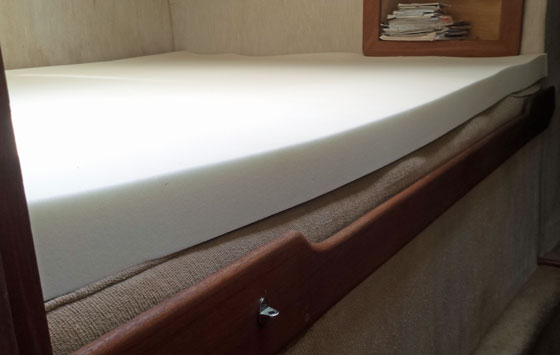
Before you spend $1,000 or more on a custom boat mattress, consider this: a quality memory foam topper over your existing cushions will very likely solve the problem for a fraction of the cost. It’s what other cruisers recommended to us, and it worked perfectly. You can choose both thickness and density to match how you sleep. (If you prefer a custom boat mattress, the Handcraft Mattress Company is an option many cruisers suggest.)
Thickness
Most people find 3″ or 4″ far more comfortable than 2″. We chose 3″ as a good compromise on weight and ease of handling aboard. If your overhead clearance is tight, keep that in mind — an extra inch of topper means an inch less headroom when you’re sitting up in bed, so going thinner may actually serve you better.
Density
Foam density runs from 3 to 6 pounds per cubic foot — the denser, the firmer. Side sleepers generally do well with 3 to 4 lb density; back sleepers usually prefer 4.5 to 6 lb. We’re both side sleepers and went with 4 lb.
Gel Foam
Newer gel versions sleep cooler but cost more. With a waterproof mattress cover (more on that below), heat hasn’t been an issue for us without the gel.
If your berth is a non-standard size or a V-berth, you can cut a topper down with a serrated knife or, much more easily, an electric knife. You can often find one inexpensively at a resale shop.
Before You Buy
- Don’t open the packaging until you’re ready to put it directly in place on the boat. If you want to let it air out first, unpack it somewhere close by — a dock, a cockpit, a friend’s slip. Once it’s out of the bag and fully expanded, you’ll never get it into the dinghy.
- It takes 2 to 4 days to fully expand after unpacking.
- It’s floppy and “sticky” — you need two people to get it down a companionway or through tight doorways.
- Expect a smell when you first open it. It’s harmless and fades within a few days to a couple of weeks. Unpack it off the boat, and let it air out first. You can also buy a natural latex topper if you’re concerned about chemicals off-gassing. They are more expensive. Pure Green is one company selling natural mattress toppers on Amazon.
This is the 3″ memory foam mattress topper (Amazon) we bought.
Waterproof Mattress Pad
Boats leak. With a mast coming through the cabin top near our berth and a hatch overhead, I wasn’t willing to risk soaking the mattress in a rainstorm or a breaking wave. Sheets and bedding can dry out; a waterproof mattress pad protects everything underneath.
Modern waterproof pads don’t feel like sleeping on a plastic tarp. Look for one described as terry cloth on the surface and “noiseless.” Make sure it’s breathable, or it’ll trap heat.
A waterproof pad also blocks allergens, mold, and mildew — which matters a lot in the marine environment. For more on keeping mold at bay aboard, see Mold and Mildew on a Boat.
Waterproof hypoallergenic mattress pad (Amazon) (various sizes available — note that V-berth shapes will likely need some customizing to fit)
Pillows
I had no idea how much a good pillow contributed to good sleep until we upgraded. My favorites are the contour “butterfly” style. They look odd, but they work beautifully. A friend I’d recommended them to wrote back: “OMG. These pillows are the best thing ever. I had no idea how much better I’d sleep.”
Odorless ergonomic contour memory foam pillows (Amazon)
Pillow Covers
With all the mold, mildew, and allergens a boat produces, we added zippered pillow encasements under our pillowcases. They go on once, you forget they’re there, and once or twice a year you pull them off and run them through a hot wash. Much easier than trying to wash expensive pillows — and it protects them for years.
One important note: make sure any encasement you buy has nylon or plastic zippers. Metal zippers rust in the marine environment.
Aller-Ease 100% cotton dust mite and allergy control pillow encasement (Amazon) (standard, queen, and king sizes available)
Sheets
Getting sheets to stay on a boat bed is one of the most maddening parts of boat life. Even with a topper, the mattress isn’t nearly as thick as a home mattress — so standard fitted sheets pop off the moment you roll over. I woke up more than once as the stuffing inside a sheet burrito.
V-berths are even worse. Standard sheets simply don’t fit.
I’ve tried elastic straps under the mattress. They work okay but are a real pain at sheet-changing time, especially when one side of the bed is against a hull. The better solution is sheets made specifically for boat beds.
Quahog Bay Bedding makes sheets for both rectangular berths and V-berths. The bottom sheet is oversized with an elastic drawstring you tighten for a snug, pop-proof fit. The fabric is 600 thread count cotton — genuinely luxurious. I’ve been using their sheets for years, and they hold up beautifully despite near-constant use. See my full Quahog Bay review for the details.
For a full comparison of all the sheet options out there, I’ve also written a guide to the best sheets for boats.
One fabric note: I prefer all-natural fabrics — cotton or bamboo — in the humid marine environment. Cotton/poly blends and microfibers feel much wetter to me and take longer to dry out from body heat when you climb in. Many cruisers speak highly of percale sheets from L L Bean, claiming they last for years.
Quilt or Duvet
Even in the Florida Keys and Mexico, there are chilly nights when you want something to burrow into. For our first year on Barefoot Gal we used an old fleece blanket — perfectly fine but nothing special.
Quahog Bay offers a duvet and several cover options with pillow shams sized for boat berths and V-berths. Worth a look if you want bedding that actually fits and feels like it belongs there.
Bedside Storage
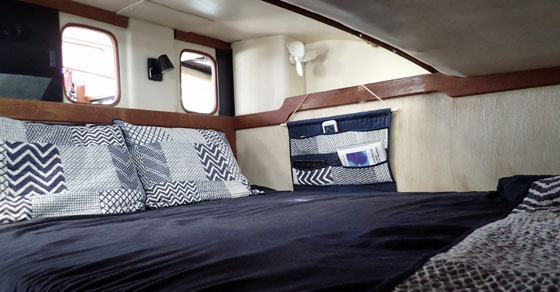
One last thing that made a real difference: somewhere to put your book, glasses, phone, and all the other things you want within reach at night. A wall-mounted pocket organizer — the kind with fabric pockets that attaches to the bulkhead beside the berth — works well in the space where a nightstand would be impossible. A quick search for “bedside wall organizer” or “bedside caddy” will turn up plenty of options.
Suggestions from Other Cruisers
These suggestions worked great for us. But personal needs and cruising grounds may require other choices. Here are a few suggestions from The Boat Galley Readers.
Addressing Condensation
If you cruise in cooler climates such as Canada or are sailing the Great Loop, you may experience condensation under your mattress. The solution is to add a layer that increases ventilation between the mattress and the fiberglass. Cruiser Bill W recommends Hypervent (Amazon). Hypervent was originally developed for landscaping, so you may be able to find it for less money in a garden center, but it comes in bigger rolls. Placing an order with other boat owners is one way to save quite a bit.
Other popular systems for increasing mattress ventilation are Dri-Dek interlocking tiles (Amazon) and the Froli Sleep System. One of the benefits of the Froli system is that it can add some spring to your sleep surface.
Other Mattress Options
Memory foam doesn’t work for everyone. Some find it too “sticky” and hard to roll over. Wendy L suggests a Tuft & Needle mattress. Made from open-cell foam, they’re soft like memory foam but without the “memory,” helpful if you toss and turn when sleeping. She found the open-cell mattress far cooler than memory foam.
DIY Ideas
Cruisers are self-reliant. If you have the time and inclination, you can create your own sleep systems. Boat owners have crafted their own mattresses and sewn their own sheets.
LaDonna T made their own mattress with foam, zippers, and fabric ordered from Sailrite. Jim Shell repurposed a four-inch sleeper sofa cushion to fit their v-berth. He rearranged the spring design and sewed a new cover. Jim credits a local canvas shop for the idea, and he used the mattress for over twelve years without rust or water issues.
Donna B sewed her own sheets to fit, purchasing a California King flat sheet for the bottom. She traced the v-berth cushions onto the sheet, added enough inches for the cushion depth and a generous hem so the sheet would fit at least four inches under the cushion. Once hemmed with elastic around the entire sheet, they stayed put easily. For top sheets, she again traced the v-berth cushions and added ten inches on all sides. At the foot, she sewed a pocket so the sheet would stay put under the berth cushions.
Other cruisers swear by a “bedroll” or “sleeping bag” solution. Bill W. sewed a bedroll that fit the v-berth, attaching the top and bottom layer up to about where a sleeper’s waist would be. Boat Galley team member Pamela D. did something similar with a king-sized duvet cover. She only had to resew the bottom of the duvet to fit the v-berth. No twisted sheets. Easy to toss in the wash.
The Payoff
Cruising shouldn’t mean making do. A comfortable bed — even a genuinely luxurious one — is achievable on a boat, and it changes your whole relationship with being aboard. When you’re well rested, you want to be out there. Passages are more enjoyable, watches feel shorter, and the boat feels like home instead of a place you’re just tolerating.
A comfortable bed is only part of the sleep picture, though. If you’re lying awake wondering whether the anchor is holding, all the memory foam in the world won’t help. Here’s how to use an anchor alarm so you can actually trust your hook and sleep soundly at anchor.
Ready to Go Further?
Bedding is one of 31 topics covered in The Basics of Living on a Boat, my course on the practical realities of life aboard that most people don’t realize they need to know until they’re already out there. If you’re in the planning stages or your first year of cruising, it’s the shortcut I wish I’d had.


Carolyn Shearlock has lived aboard full-time for 17 years, splitting her time between a Tayana 37 monohull and a Gemini 105 catamaran. She’s cruised over 14,000 miles, from Pacific Mexico and Central America to Florida and the Bahamas, gaining firsthand experience with the joys and challenges of life on the water.
Through The Boat Galley, Carolyn has helped thousands of people explore, prepare for, and enjoy life afloat. She shares her expertise as an instructor at Cruisers University, in leading boating publications, and through her bestselling book, The Boat Galley Cookbook. She is passionate about helping others embark on their liveaboard journey—making life on the water simpler, safer, and more enjoyable.
Leave a Reply