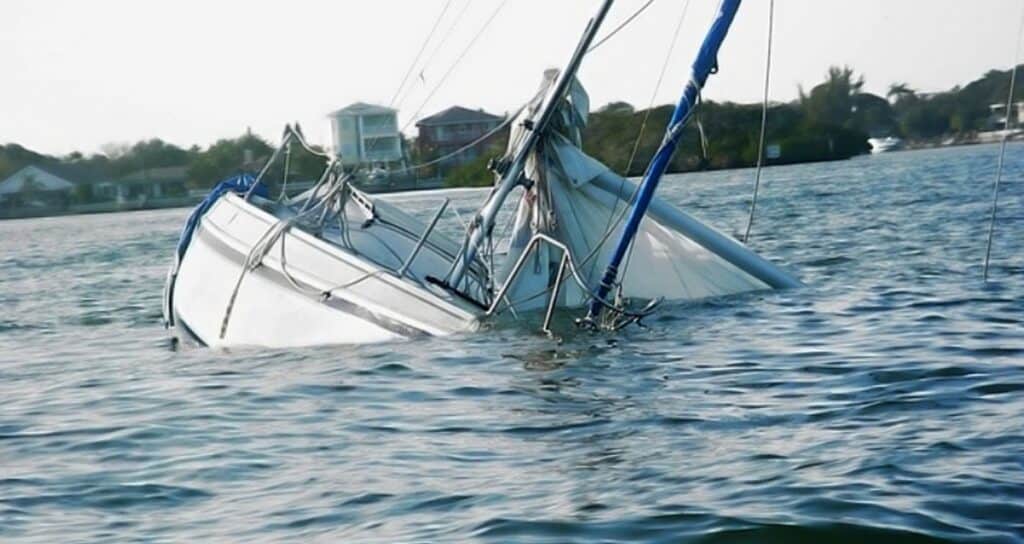
Although we had a bilge alarm on our first boat, a monohull, a shocking story about a catamaran of the same make as Barefoot Gal got us thinking. Would we regret it if we didn’t add bilge alarms onboard as well?
One Cruiser’s Bad Day
A while back, we got the horrible news that another Gemini took on water and sank underway to the Bahamas. Their buddy boat rescued the two people aboard with no injuries. But they lost their boat.
The owner publicly said that they discovered two inches of water over the floorboards in one hull around midnight. They were unable to determine the source of the water. Within twenty minutes, they had to abandon the boat as it was about to capsize due to all the water in one hull. Would this story have ended differently if they had installed bilge alarms in both hulls?
The Role of a Bilge Alarm
A bilge alarm will notify you there’s a problem even before the bilge pump kicks on. If you have a big problem, even a few minutes’ early warning might save your boat.
Twice on our previous boat, Que Tal, our bilge alarm alerted us to problems: once an improperly replaced stuffing box after we’d been on the hard, and another time we had a pinhole leak in our freshwater tank.
That got Dave and me thinking. Barefoot Gal did not have an “early warning system” for water intrusion. Our previous boat, a Tayana 37 with deep bilges, had a very loud alarm on the primary bilge pump. If the pump ran, you knew it. And you could/would investigate.
Twice, the sound alerted us to a problem. Once, when the fresh water tank developed a leak. And the second alert sounded when someone installed the stuffing box upside down after work.
To have any chance of saving the boat in the event of a thru-hull failure or any other water intrusion, you have to know about it as soon as possible. You also need the tools and a plan to stop the leak. Our previous experience and the story from the Bahamas told us it was time to install our own early -warning system, so I began to do some research.
Researching Bilge Alarms
I started by looking at bilge alarms from various marine sources. I discovered that they tended to be expensive, hard-wired (hence, time-consuming to install), and most were designed for a light and alarm at the helm. Nothing wrong with them, but just seemed like overkill for a boat like ours. We don’t believe in “cheaping out” when it comes to safety equipment, but we thought that something simpler would actually be better.
Continuing to search, I was able to find a better solution for our needs: a home “leak detector.” A leak detector sounds an alarm (similar to a smoke detector) when it detects water. Homeowners typically use them near hot water heaters, washing machines, dishwashers, under sinks, toilets, and near sumps. Luckily, one listed “boat bilges” as a possible use, and Google picked up on it! (Disclaimer: while we thought the options I share below were right for us, you have to decide if they’re right for you.)
Bilge Alarm Options
Several different companies make leak detectors, and each has at least a couple of models. After looking at many product listings and reviews on Amazon, I started picking up on some differences:
- Some are single-use and come with the battery preinstalled. They’re slightly cheaper, but you can’t test them. And if they get wet once (say you leave a hatch open, it rains, and water gets in the bilge), you have to replace them.
- Some do not float – if there is a lot of water, they’ll beep maybe once or twice, then silently die.
- Some have batteries that you cannot replace.
- A few you can only turn off by removing the battery. Just drying the contacts won’t stop the alarm.
- Most but not all have a low battery alert – generally a chirp similar to a smoke detector.
- Some have a lot of reviews saying that they’re not all that loud.
All will detect water somewhere in the 1/32” to 1/16” deep range. That’s actually a little oversensitive for us, as even a few drops of water from changing the speed log to the dummy plug when at anchor or a tiny leak in a hatch would set it off. But you can set up the gizmo so it’s not quite in the lowest point of the bilge. This is what we did. It takes a couple of gallons of water to trigger the alarm. Or you could glue a small strip of wood to one end of the bottom so that it would take more than just a few drops of water to sound the alarm (we don’t want a lot of nuisance alarms).
Setting Up Your Bilge Alarm
You can do bilge alarms several different ways:
- Wire it into the bilge pump circuit so that if the bilge pump goes on, the alarm will sound (what we had on our previous boat)
- Put it on a separate circuit with a float switch to trip it. The advantages are having two fewer connections in the bilge circuit, fewer possible points of failure, and that you can possibly mount the float switch lower than the float switch for the bilge pump.
- Use a separate battery-powered water alarm. These are very easy to install, but don’t have nearly the battery life or loudness of one that’s wired into the house batteries. However, they also won’t drain the house batteries if the bilge pump is needed. And it’s easy to turn off the alarm, whereas hard-wired ones can’t be unless you install a switch.
- There are also stand-alone alarms that can send a message to a cell phone if you keep your boat at a marina where wifi is available. They’ll also let you know if power or wifi goes down. These are good if you only occasionally stay on the boat, so that you know of a problem when you’re not there.
Do any of these methods make sense for you? Your preference can help to guide your choice.
But, if you’re not yet convinced, let me tell you about one time our bilge alarm went off on Barefoot Gal. Hopefully, it will help you decide in favor of an early warning system of your own.
Our Alert From the Bilge Alarm
Fortunately, our story had a much happier ending than that of the Gemini in the Bahamas. We were doing our normal morning stuff aboard Barefoot Gal. I was replying to some emails, and Dave had just brushed his teeth. Suddenly, we heard a loud whistling noise coming from the port side of the boat. The bilge alarm??
Yep.
Dave was standing right over the bilge access panel and looked in. He was rather shocked to find a couple of inches of water in the bilge, which is normally dry (Barefoot Gal is a catamaran, there’s no stuffing box, and her bilges are very shallow). We typically check it every few days, and there is just never anything in it.
The water wasn’t yet deep enough for the automatic bilge pump to kick on. But the alarm told us we had a potential problem.
Troubleshooting
We immediately began troubleshooting. The first thing to check in a situation like this is whether the water is fresh or salt, so you know where to start looking. Next, we checked the rate of flow.
Although tasting water is what many boaters do, it’s not exactly safe if there are fuel or chemicals in the water. A salinity tester (Amazon) is a useful tool to have on board. You’ll find that helpful tip, as well as the exact next steps to follow whether your water leak is fresh or salt, in The Basics of Living on a Boat, part of the All-Access Pass of The Boat Galley Courses.
Our leak was nothing that would sink the boat; that much was immediately clear. After a full day of checking, we knew lots of things that it wasn’t. We checked all the potentially big problem areas, and they weren’t to blame. Our final conclusion was that we had a tiny crack in a water hose where it went on a hose barb. We fixed it and waited to see if any more water appeared. We spent the day checking the bilge every half hour. But really, the source of the water isn’t the topic of this article.
I hope you see the importance of having a bilge alarm. But I also want you to know that choosing something is better than landing on the perfect option right away. We started simple, and as we learned more, we chose options that worked better for us.
Our Bilge Alarm Choices Over the Years
For our first alarm on Barefoot Gal, we opted for a “hot water heater” alarm that runs on a 9-volt battery. It wasn’t as loud as some others, but it was still loud enough that we could hear it over the diesel engine. We liked that in an emergency, we could silence it by drying the contacts or just pulling the battery. While we liked having an alarm tell us of a problem, we did not like one constantly sounding as we were troubleshooting! The package said that one battery would last up to 5 years, and that the alarm will sound for 3 days if activated. Just to be on the safe side, we used a lithium 9-volt battery and replaced it every year on our anniversary (the old one got put into a blood pressure cuff, where we would see if it dies).
You can buy 12-volt or battery-powered alarms in many places, such as automotive, hardware, or home improvement stores. There are probably hundreds of different models available, and they’re quite inexpensive for the peace of mind. Marine stores also sell more expensive “marine” alarms, and I honestly don’t see that they are any better. Over the years, we’ve upgraded a few times. I’m listing each one we’ve used so you can consider which is the best option for you. For both boats, we’ve bought alarms on Amazon:
- 12-volt 85-decibel alarm (2-pack; we used a predecessor model on Que Tal)
- Zircon Leak Alert Electronic Water Detectors (some packages come with batteries, but don’t forget the spares)
- Gentronics 9-volt battery water alarm (what we last used on Barefoot Gal)
- Lithium 9-volt batteries (Lithium batteries have by far the longest life in devices such as this and are worth the extra expense)
Dave and I got alarms for each hull/bilge. Depending on your boat and bilge configuration, you might want additional water detectors near a freshwater tank or near your holding tank to tell you of problems in those areas, too. They are relatively inexpensive, so they are a cost-effective early warning system.
Other Cruisers Suggest
I have not used an alarm that sends a message, but a guy that stopped by our booth did tell me about one they were using while I was at the Annapolis Sailboat Show. A particularly nice feature of his suggestion is that it was powered by a cord that plugs into a USB socket, which most boats have. Then you simply need a reasonably good wifi connection (not a hotspot from your phone which will not be available when you take your phone off the boat).
Don’t Lose Your Boat
If you find and fix the problem quickly enough, you a save your boat from a terrible end. Adding an inexpensive bilge alarm is a minor upgrade that I promise you won’t regret adding to your boat.
Learn More
Knowing what to do if you discover water coming into your boat is critical if you live on a boat. If you want a clear, practical overview of what boat life actually involves day to day as well as step-by-step instructions for all the unfamiliar tasks — such as what to do if you discover water coming in — our on-demand online course The Basics of Living on a Boat walks through the things most people don’t even realize they need to know.


Carolyn Shearlock has lived aboard full-time for 17 years, splitting her time between a Tayana 37 monohull and a Gemini 105 catamaran. She’s cruised over 14,000 miles, from Pacific Mexico and Central America to Florida and the Bahamas, gaining firsthand experience with the joys and challenges of life on the water.
Through The Boat Galley, Carolyn has helped thousands of people explore, prepare for, and enjoy life afloat. She shares her expertise as an instructor at Cruisers University, in leading boating publications, and through her bestselling book, The Boat Galley Cookbook. She is passionate about helping others embark on their liveaboard journey—making life on the water simpler, safer, and more enjoyable.
Leave a Reply