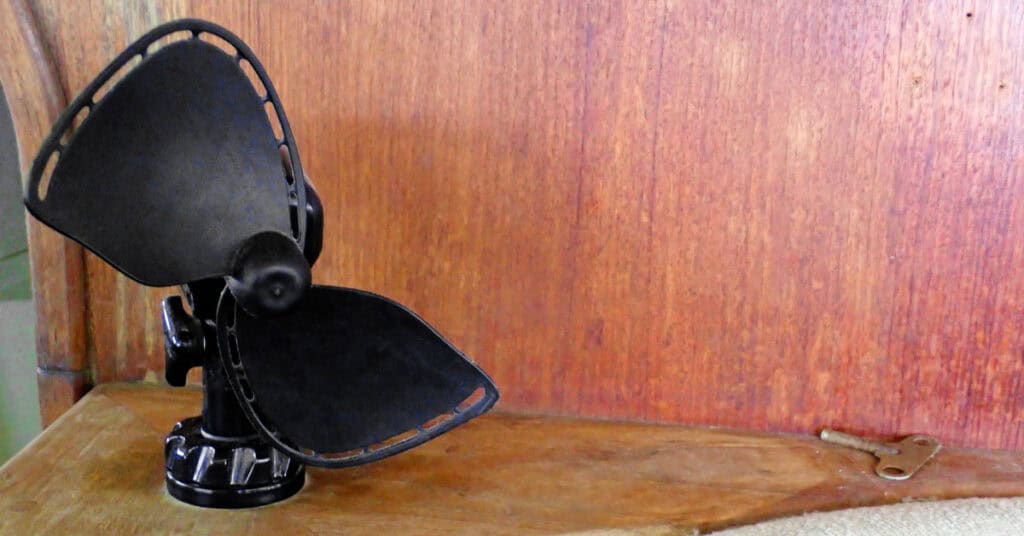
The best setup for keeping cool on a boat without AC takes two types of fans: permanently mounted fans throughout the boat, and a portable that goes anywhere you need it. We spent years getting our fan situation dialed in across two boats and 14,000 miles of cruising in the Sea of Cortez, the Florida Keys, and the Bahamas, and what we landed on made a bigger difference than anything else we tried.
The Caframo Cageless 12-Volt Fan
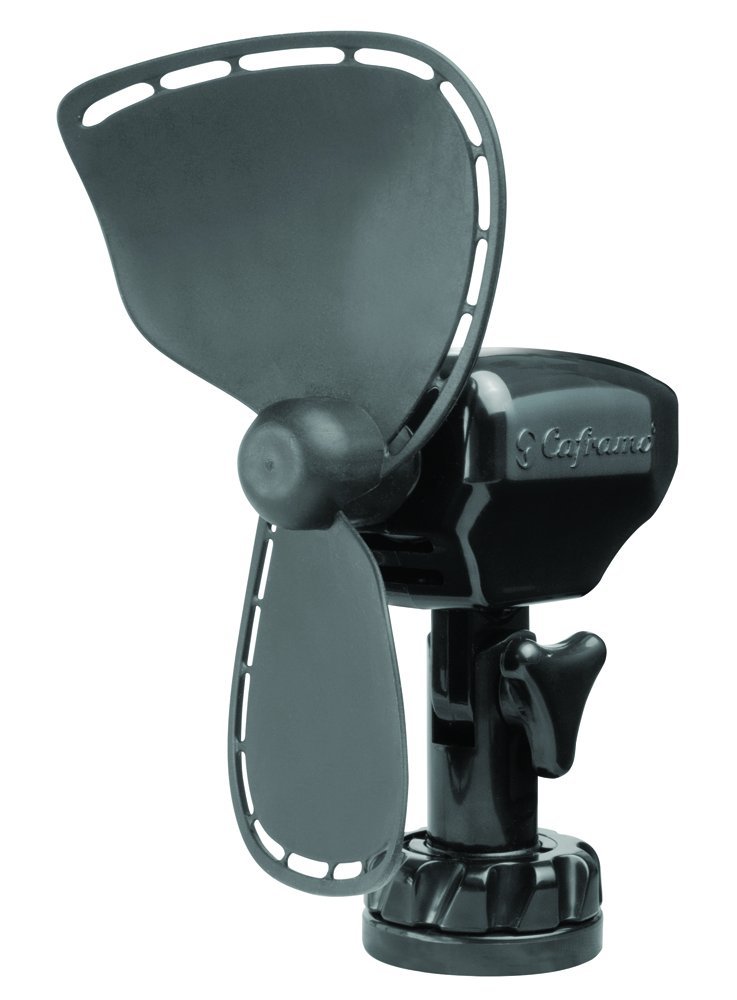
The single most important thing about a 12-volt boat fan isn’t the brand — it’s whether it has a cage. Some fans will spec out moving more total air, but a blade guard blocks a significant portion of that airflow before it ever reaches you. What matters is the air that actually gets to you, not what the fan pushes into the cage.
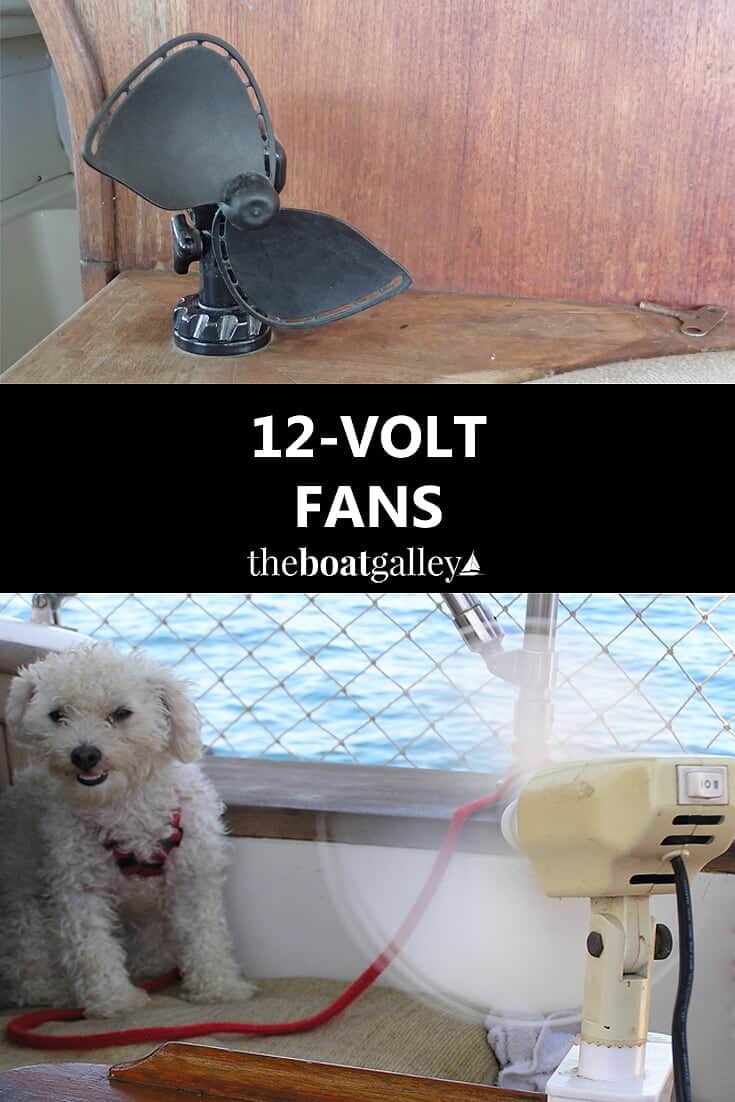
The Caframo Ultimate Fan (Amazon) has no cage. Soft, flexible FingerSafe blades push all the air directly at you. I’ve put my hand into a running one more than once — it stops immediately, and it doesn’t hurt any more than knocking on a door does. Yes, you notice it. But the blades are soft and finger-safe, even for kids.
Other options exist — Hella fans, the caged Caframo models, and the lighter-plug Caframo version — but they all come with tradeoffs. The Hella and caged Caframo models have blade guards, which is exactly what you’re trying to avoid. The lighter-plug version (Amazon) works fine if it suits your installation, but the direct-wire model is cheaper and the hardwired connection is more reliable.
Caframo Ultimate specs:
- Blade diameter: 5.25″
- Total height with base: 8″
- Airflow: 200 CFM on high
- Current draw: 0.41A on high, 0.28A on low
- 2 speeds plus off, controlled by a rocker switch on the fan
- No interference with VHF, radar, autopilot, or other instruments
Installation
The fan ships with both a suction cup base and a screw-in base. Skip the suction cups — they don’t hold. Use the screw-in base for all permanent mounts. Even with a fixed base, you can still adjust the fan’s angle after mounting. Wire it directly into your 12V system; the rocker switch handles on/off, so hardwiring doesn’t mean it runs constantly.
Where to put them
Most cruisers end up with more fans than they expected, especially in a hot climate. Most boats want a fan in the following areas:
- Saloon (likely 2 or more)
- Galley
- Nav station
- Head
- Each cabin or berth (1 or 2 depending on size and layout)
- Quarterberth
- Lazarette
On our Tayana 37, Que Tal, we had 6 hardwired fans. On our Gemini 105, Barefoot Gal, we had 5. We kept a couple of spares on both boats too — fans were too important to our comfort in hot climates to be caught without one if something failed, though honestly failures were rare.
How long do they last?
Fans that ran virtually around the clock needed replacing at around 5 years. Others were still going strong when we sold Que Tal after 7 years and Barefoot Gal after 10.
As the fans age, you may notice some vibration and noise. We found it was the blade becoming loose or very slightly out of balance. Replacement blades are a 30-second swap with no tools — worth keeping a few on hand, both for age-related wear and in case something large falls against a fan and breaks a blade.
If a fan suddenly stops working, check your wiring before assuming the fan is shot. Our guide to troubleshooting boat electrical problems walks through the most common causes.
The Fan That Goes Where You Need It: A Rechargeable Portable
The permanently mounted Caframos cover every spot on the boat where you need steady airflow. But sometimes you need air on you in a place those fans don’t reach — head in a locker tracing an electrical problem, elbow-deep in the engine compartment, sitting in the cockpit on a still evening.
Both of our boats had 2 portable fans in addition to the permanently mounted ones. On Que Tal, those were corded fans — extension cords draped wherever we needed air, and it was a real pain. By the time we had Barefoot Gal, good cordless rechargeables were available, and there was no going back.
A rechargeable portable runs on its own battery, draws nothing from the boat’s electrical system while running, and recharges from any USB port or cigarette lighter adapter when power is available. No outlet needed where you want the fan — just grab it and go.
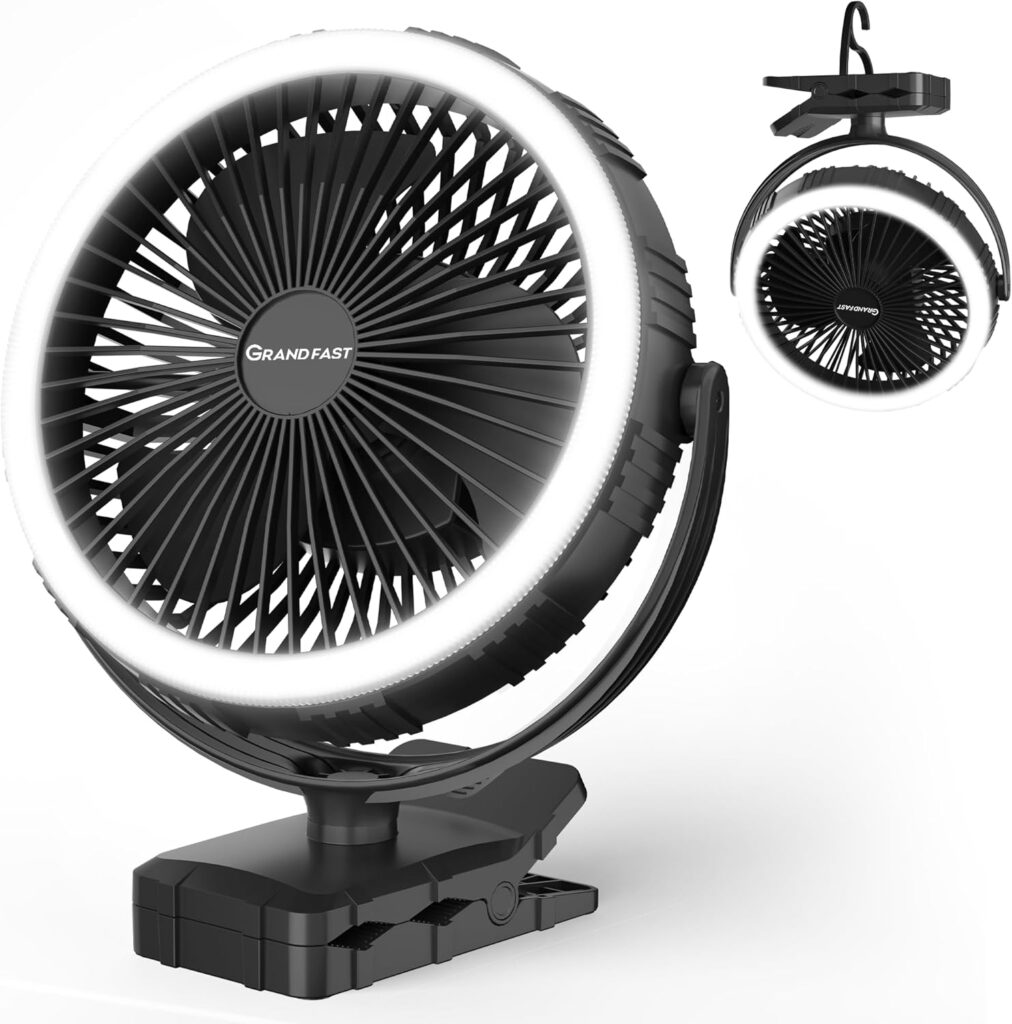
The fan we use is the GRANDFAST rechargeable fan (Amazon).
GRANDFAST specs:
- 8″ blades
- 3 speeds
- 10,000mAh battery
- Up to 20 hours runtime on a charge
- Charges via USB-C in 4-5 hours
- Strong clamp and collapsible hook both included
- 360° swivel
- Built-in LED light, 740 lux, 3 brightness levels
That last feature earns a mention: when you’re working in a tight space on a boat project, having both air and light from the same thing you’re already holding turns out to be genuinely useful.
One More Thing: A Wind Scoop
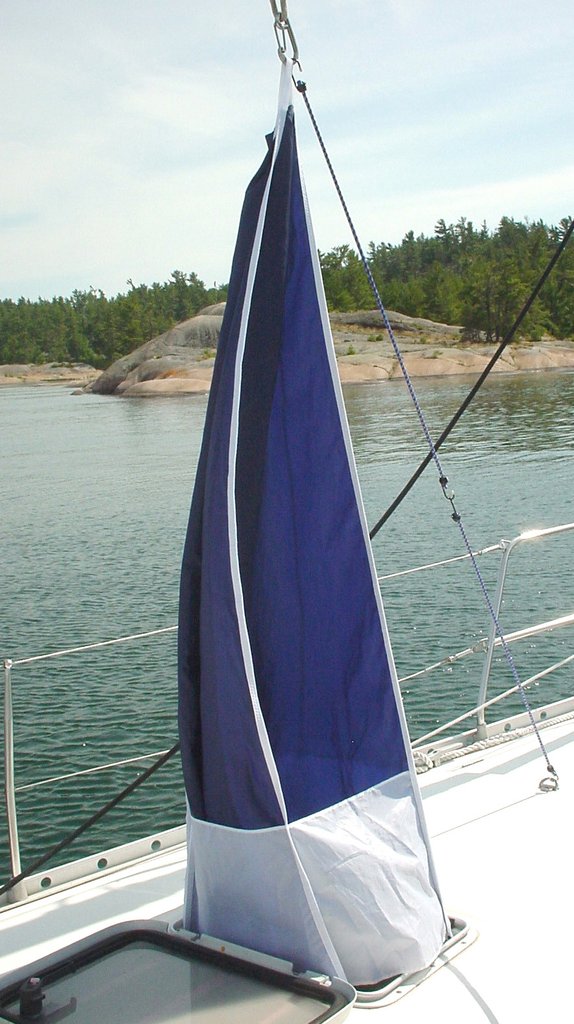
Fans move the air that’s already below decks. A wind scoop dramatically increases how much fresh air comes in through an open hatch — and that’s what lets your fans actually do their job.
To push hot air out, fresh air has to come in to replace it. The more that’s coming in, the more effectively your fans can move heat from cooking, laptops, and electrical equipment out of the boat. An open hatch helps, but a wind scoop channels significantly more air below decks than an open hatch alone. In a hot anchorage, the difference is real.
A 4-way wind scoop catches a breeze from any direction, which matters when you’re swinging at anchor and the wind keeps shifting. The Breeze Bandit is what we used on both boats. For more on choosing one, see our guide to wind scoops for sailboats.
Links to Buy
Caframo Ultimate Fan (Amazon) — the direct-wire, cageless 12-volt fan we recommend for permanent installation throughout the boat.
GRANDFAST rechargeable fan (Amazon) — the cordless portable fan for anywhere the permanently mounted fans don’t reach.
Breeze Bandit 4-way wind scoop — channels significantly more air below decks than an open hatch alone.

Carolyn Shearlock has lived aboard full-time for 17 years, splitting her time between a Tayana 37 monohull and a Gemini 105 catamaran. She’s cruised over 14,000 miles, from Pacific Mexico and Central America to Florida and the Bahamas, gaining firsthand experience with the joys and challenges of life on the water.
Through The Boat Galley, Carolyn has helped thousands of people explore, prepare for, and enjoy life afloat. She shares her expertise as an instructor at Cruisers University, in leading boating publications, and through her bestselling book, The Boat Galley Cookbook. She is passionate about helping others embark on their liveaboard journey—making life on the water simpler, safer, and more enjoyable.
The Boat Galley says
Ventilation in South Florida is a priority!
Carolyn Shearlock says
Congrats! If you’re troubled by no-see-ums, try getting some bridal veil material and using it to cover the hatches. It definitely cuts down on the airflow, but is small enough to keep the no-see-ums out.
Rod Rodgers says
Ok Bill. we get it. you have boat issues consistently.
Carolyn Shearlock says
Test that you’ve got full 12 volts — if the blades are turning but slowly, voltage could be a problem. If that’s not an issue, I’d then think maybe a bad unit and get it replaced under warranty. I’ve only used the ones without a cage and they have always worked really, really well. I know some people with other models have had problems with some being dead out of the box.
Carolyn Shearlock says
I have only used the two-speed Caframo and they have worked very well for us. I’ve heard from others that some of the more expensive models — with more speeds and finger guards, etc. — don’t work as well.
Carolyn Shearlock says
Sometimes the wires run behind the headliner, other times under the floor or along the hull in lockers. When you start looking, you’ll find the existing ones. You really should run the wire from the electrical panel (on an existing breaker or perhaps a bus bar) and not directlty from the batteries. If you’re not familiar with 12 volt wiring, get a copy of Don Casey’s book — it’s great if you’re just learning. Nigel Calder is also good, but assumes that you already know quite a bit. Don Casey’s Sailboat Electrics Simplified on Amazon or Don Casey’s Complete Illustrated Sailboat Maintenance Manual (contains the electrics book in its entirety plus 5 other good reference books). We have the second and use it frequently!
Carolyn Shearlock says
I don’t have one, and the owner’s manual does not say (helpful, huh?). I’d call Caframo at 800-567-3556 or via email (see their contact page).
Kevin Leonard says
You have the positive & negative reversed, so the fan is sucking and not blowing. Reverse the connections, that should correct your issue.
Carolyn Shearlock says
Just wipe the blades off. Actually, I’d remove the blade every 2 or 3 months so that I could really clean it, then put it back on.
Rebeca says
Great perspective, thanks for sharing.