
Adding extra insulation to your galley refrigerator can dramatically lessen the power needed. Below are 4 simple and inexpensive ways to add extra insulation without rebuilding your boat’s refrigerator.
Aboard Que Tal, Dave and I cruised the Sea of Cortez and as far south as El Salvador, where summer temperatures were often over 100 for days on end. On top of the heat, our refrigerator was next to the engine compartment and next to the companionway with the sun beating down on the (dark) teak surround. We quickly figured out how to add extra insulation without totally rebuilding the refrigeration box (which would have been a very messy and expensive option).
1. Counter Mat. I got a foam exercise mat, cut it to the exact dimensions of the counter top (less 1/2″ all around) and had a canvas shop put a white scrub-able vinyl cover over it (the seams made up that 1/2″ so it was now the exact size of the counter top) and laid it on the counter over the fridge.
Why the vinyl cover? Since this was my main food prep counter, the vinyl made it easy to keep clean, as the mat I got had a porous surface. Newer mats, such as the one recommended here, have a washable surface and may not need a cover depending on how much food prep you do on this area. For me, the other reason was that the only suitable mat I could find was black. One of my problems was that the top of the refrigerator was in full sunlight, so I wanted a white surface that wouldn’t absorb heat, and the vinyl cover gave me that.
To get into the fridge, I just flipped the cover back.
I recommend a 3/8″ thick mat for two reasons — while a thicker one will have more insulating power, it is also more difficult to cut to size, and will be stiffer and hard to keep “flipped back” when you want to get into the refrigerator. You need one that is flat on both the top and bottom — on top, so that you can use it as a counter area and on the bottom so that air doesn’t get between the mat and the top of the refrigerator.
My recommendation, from Amazon.com:
2. Auto Windshield Reflectors. We got two auto windshield reflectors and duct-taped one around the outside of the refrigerator with the silver side out to keep that teak enclosure from heating up. It was easy to cut it to the exact size needed and while it didn’t look pretty, it considerably reduced the drain on our batteries.
The other reflector we cut to size and laid it inside the fridge on top of all the food. We had two access lids into the refrigerator, side by side, and used one far more frequently than the other. Eventually we cut the reflector down again and just used it over the side with the chill plate, which we got into much less frequently — we had discovered that having an extra layer of insulation on the side we used frequently just made it too hard to get to the drinks.
The reflector doesn’t need to be anything special, unless you want a particular color or design to improve the appearance of the one that’s visible (Wal-mart, Target and auto parts stores often have ones with sports logos, Disney characters and so on — at a price).
3. Foam Insulation Sheets. Friends on a boat in the US bought some rigid foam insulation (large blue and pink sheets available at home improvement stores) and cut pieces to fit in their refrigerator and inside the lid, then used silicone (or even just duct tape) to hold them in place.
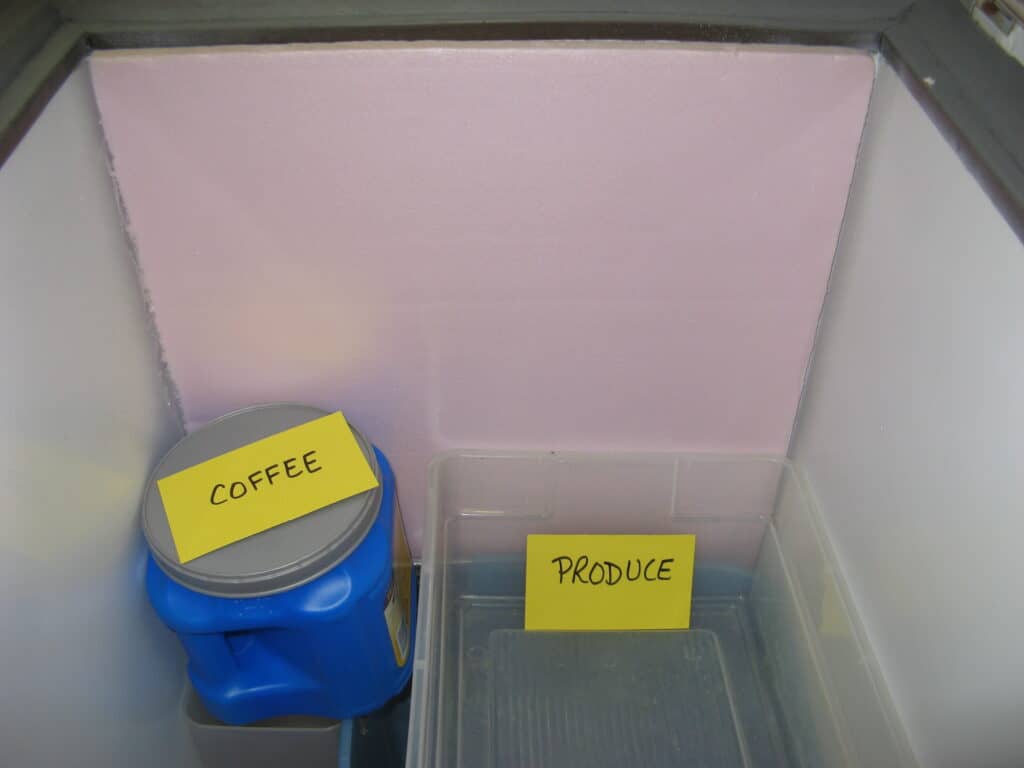
We weren’t able to find the rigid foam where we were, but I know several people who have done this and all said that it made a significant improvement, didn’t take a lot of space out of the refrigerator, and was easy to do, taking less than an hour. Don’t put it on the bottom of the refrigerator or in the bottom 4″ of the sides, as meltwater from defrosting will saturate the foam.
4. Hanging Sun Shield. Almost every boat in the Sea of Cortez for the summer hung something — an auto windshield reflector, a piece of white Sunbrella, whatever — on the outside of the hull over the refrigerator area. Dark-hulled boats said this made a HUGE difference to them; we noticed a small improvement (we had a very high gloss new white paint job).
We also tried putting some insulation inside the engine compartment on the wall common to the refrigerator. Unfortunately, there was very little room for insulation and it didn’t make much of a difference.
UPDATE: After I wrote this article, other cruisers told me about using Reflectix to easily add additional insulation. Read about it here.
If you want to delve deeper into boat refrigeration or are considering replacing yours, I heartily recommend Nigel Calder’s book on the subject:


Carolyn Shearlock has lived aboard full-time for 17 years, splitting her time between a Tayana 37 monohull and a Gemini 105 catamaran. She’s cruised over 14,000 miles, from Pacific Mexico and Central America to Florida and the Bahamas, gaining firsthand experience with the joys and challenges of life on the water.
Through The Boat Galley, Carolyn has helped thousands of people explore, prepare for, and enjoy life afloat. She shares her expertise as an instructor at Cruisers University, in leading boating publications, and through her bestselling book, The Boat Galley Cookbook. She is passionate about helping others embark on their liveaboard journey—making life on the water simpler, safer, and more enjoyable.
Mary Dixon says
When we lived on our Morgan O/I 41, the insulation wasn’t very good on the frig. So, we drilled several holes all inside the frig and sprayed the expanding foam, then covered up the holes with fiberglass resin. Be careful to not spray too much since it expands. I had one small “bump” in the wall of the frig where it bulged out from too much foam.
Tara says
We have a front loading fridge and freezer. We hung plastic strips (about 2 inches wide) on the inside of both to limit the amount of cold air that escapes when opening the doors and reaching in for something. We started with a wood rail slightly wider than the opening and stapled the plastic strips to the wood. The piece of wood was screwed into the inside of the fridge with the plastic strips between it and the fiberglass (so the strips are sandwiched in there and won’t fall off). This is not unique – you might see in a large walk-in fridge or freezer, but it definitely keeps the cold in!
Carolyn Shearlock says
Those plastic strips are called “replacement strips for curtain doors” (or variations on that). You may be able to find them at a commercial refrigerator store if you’re in a large city. Otherwise, I can find one place that sells the replacement strips in 7 or 8 foot lengths (most places sell them in 200+ foot rolls, way more than you’d need on a boat). I can only find 6″ wide strips, which could be cut lengthwise to make 2″ or 3″ strips:
6″ wide strips: Tundra Specialities (I don’t know a thing about this company, but they are the ONLY place I could find selling individual 6″ wide strips)
Mary says
My mother has done this in her canning room (like a pantry on steroids) at home, using vinyl shower curtain liners cut into strips and stapled, each strip overlapping the other by a little bit, onto a header strip of wood about an inch wide and 1/2 inch or less thick. Cheaper and more easily available than the replacement strips for curtain doors mentioned above, although perhaps not as thick. She does this to keep the dust from building up on the jars as the shelves are otherwise open.
Carolyn Shearlock says
The vinyl in the true refrigerator strips is fairly thick, providing for better insulation. However, the shower curtain idea would definitely keep more cold air in a front-loading refrigerator than nothing!
Carolyn Shearlock says
Debi left this comment on The Boat Galley’s Facebook page:
Another idea: As your freezer box empties out, fill in the space with “insulation”. I bought several cheap plastic containers and filled them with spray insulating foam. Frozen food out, foam filled container in. Works great! (BTW you’re right, spray too much of that foam in a confined space and it will expand all over the place!)
DSmith says
I hate to let all that freezer space go to waste, esp. when the temps are warm. I’d recommend filling those cheap plastic containers with water and letting them freeze. Whether using the blocks for a separate cooler, or chipping them down for iced drinks, the space is used efficiently (and provides a back-up source of clean water).
Steven Charlebois says
I know that you can buy insulating foam that only expands a small amount and this type of foam would work better than the expanding type since it is always hard to judge how much it is going to expand. Most hardware stores sell this type of insulating foam. One product is called Great Stuff Window and Doors minimally expanding foam. This would help prevent the bulges from the foam over expanding when insulating around a refrigerator.
Dan Thomas says
Several thoughts here:
1) Is that you get bigger air bubbles in the regular expanding foam, and smaller ones in the minimally expanding foam. The bigger air bubbles is what gives you more R factor. So you get less insulating with the smaller air bubbles.
2) You can leave holes for the foam to expand out from the area intended. Then trim them up to fit the area. Also tape around holes and use plastic drop clothes for painting for the foam to expand onto. Then throw away the plastic sheeting and tape.
3) Use smaller amounts and let it expand all it going to then add more so that you don’t use too much foam. Thus causing the sides to bow in or out.
4) If you are refoaming then you are into a major rebuilt. Reinforcement of the sides will help in the bowing in from to much foam. Several ways to do this, but that is a whole other topic.
Tami says
I thought I got this idea from you: I keep drinks in a cooler so as not to go into the fridge as frequently.
In regards foam containers and space fill, I made a pillow stuffed with packing styrofoam bits. Better than the landfill, anyway
Tami says
Pillow for the fridge that is.
Diane says
When in Mexico we “stored” our 2 small Polartec fleece blankets by folding them slightly larger than the top of the fridge & freezer lids and kept them covering the lids. We’d flip them over once or twice a day so they would not get too damp. They never mildewed, but did need an occasional washing since they were in the galley. We’d toss them aside when we used the counter space. In hot weather it made about 5-10 degrees difference on the top of both units.
For those small areas where we didn’t want want food inside the fridge/freezer we use bubble wrap for fill.
Pamela F Tucker says
Carolyn,
First thanks for your post, but I am confused. I don’t understand why you would need to move something on your counter to get into your refrigerator.
Kind Regards,
Pamela
Carolyn Shearlock says
It’s a top loading refrigerator that you get into through an opening in the counter.
Pamela F Tucker says
Oh wow! That’s cool! Thanks!
Pamela
Barbara Lowell says
i am really surprised no one mentions here the absolute toxic nature of spray foam and in fact all foam and all cones, like silicones. These are all petroleum products to some degree or another, and not food grade. They emit fumes that may even have a slight taste. I would only do this with food grade recycled maybe from acceptable sources like food grade coolers or some such. Just sayin. Poisons may seem innocent but they accumulate in the body and cannot easily be discarded, mess with our immune systems and hormones.
S/V Amity says
Put the ice you remove during the defrosting operation in a ziplock bag. When restarting the fridge, put the sealed bag of ice in the fridge. You’ve already paid in amps to make the ice so use it to help the compressor draw down the temp a little faster.
Tiffany says
Our fridge is one of our biggest stressers. It’s a top loading. It has never worked super efficiently and has a leak so every year or so we have to get the Fridge person to come and add more refrigerant and we need to at some point replace our evaporator plate. Of course the other day while cleaning the freezer I seem to have broken something as, it no longer works. We also have put some thin strips of insulation I think like meant for windows and doors on the rim running around the edge of the counters to help from air leaking out. But they don’t seem to really stay put when the counter gets wet from washing or doing other things. Thinking about also maybe getting a standalone unit just as a back up that could be used as a fridge or freezer. We have quite a bit of solar for our needs. We do all work ourselves, so totally overwhelmed with the projects and haven’t really done enough for the Fridge. But of course we are also cruising where it’s above 90°F and don’t have air-conditioning either. Love all your articles.
Carolyn Shearlock says
Cruising without a refrigerator, especially when it’s hot, isn’t fun. I suggest going ahead and getting a standalone unit NOW and then if/when you have time to work on the existing fridge, great — it’ll just give you more space. But getting a Engel, Whynter, Dometic or similar — it’ll be up and running 5 minutes after you get it to the boat. And you say you’ve got plenty of solar, it shouldn’t cause a strain on the power equation. In fact, you’ll probably be surprised at how much less power it takes than the old poorly-performing one.